Gasteria
The genus Gasteria brings together some thirty succulents endemic to South Africa, mostly from the Eastern and Western Cape, where they grow among rocks or in the shade of shrubs in coastal thicket and Karoo scrub. They belong to the Asphodelaceae, the same family as Aloe and Haworthia, and the name comes from the Latin gaster, stomach. It refers not to the leaves but to the flower: a curved tube with a swollen, pot-bellied base, red or pink below and green at the tip, carried on arching racemes in late winter and spring. In habitat they are bird flowers, pollinated by sunbirds.
3 plants in Gasteria
How to recognise them
The leaves are thick and tongue-shaped, blunt-tipped, sometimes keeled underneath, and either smooth and glossy or covered in rough tubercles depending on the species. One detail catches people out: young plants hold their leaves distichously, in two opposite ranks like a flat fan, and many species only twist into a rosette as they mature. A juvenile and an adult of the same plant can look like two different species.
These are the ones we stock:
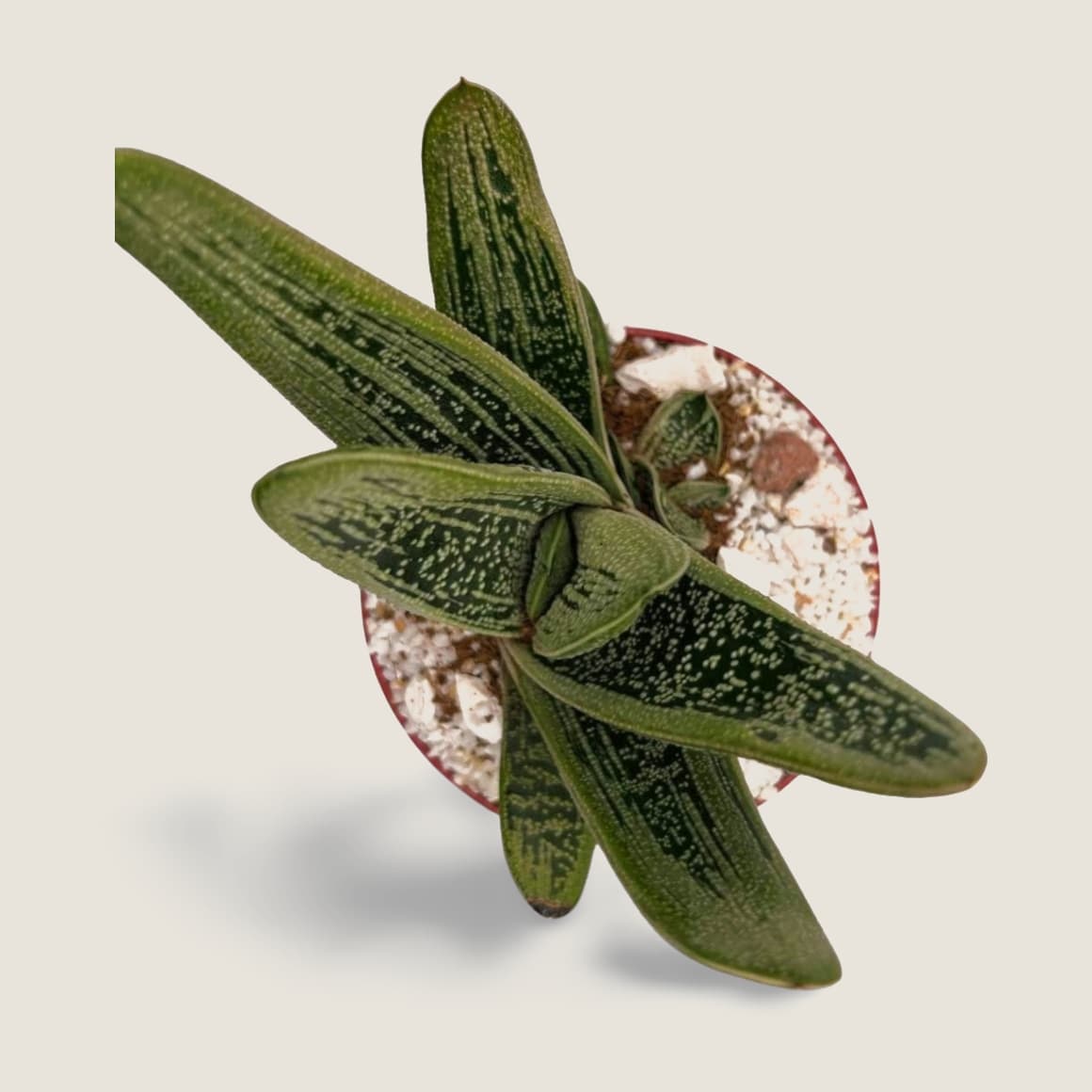
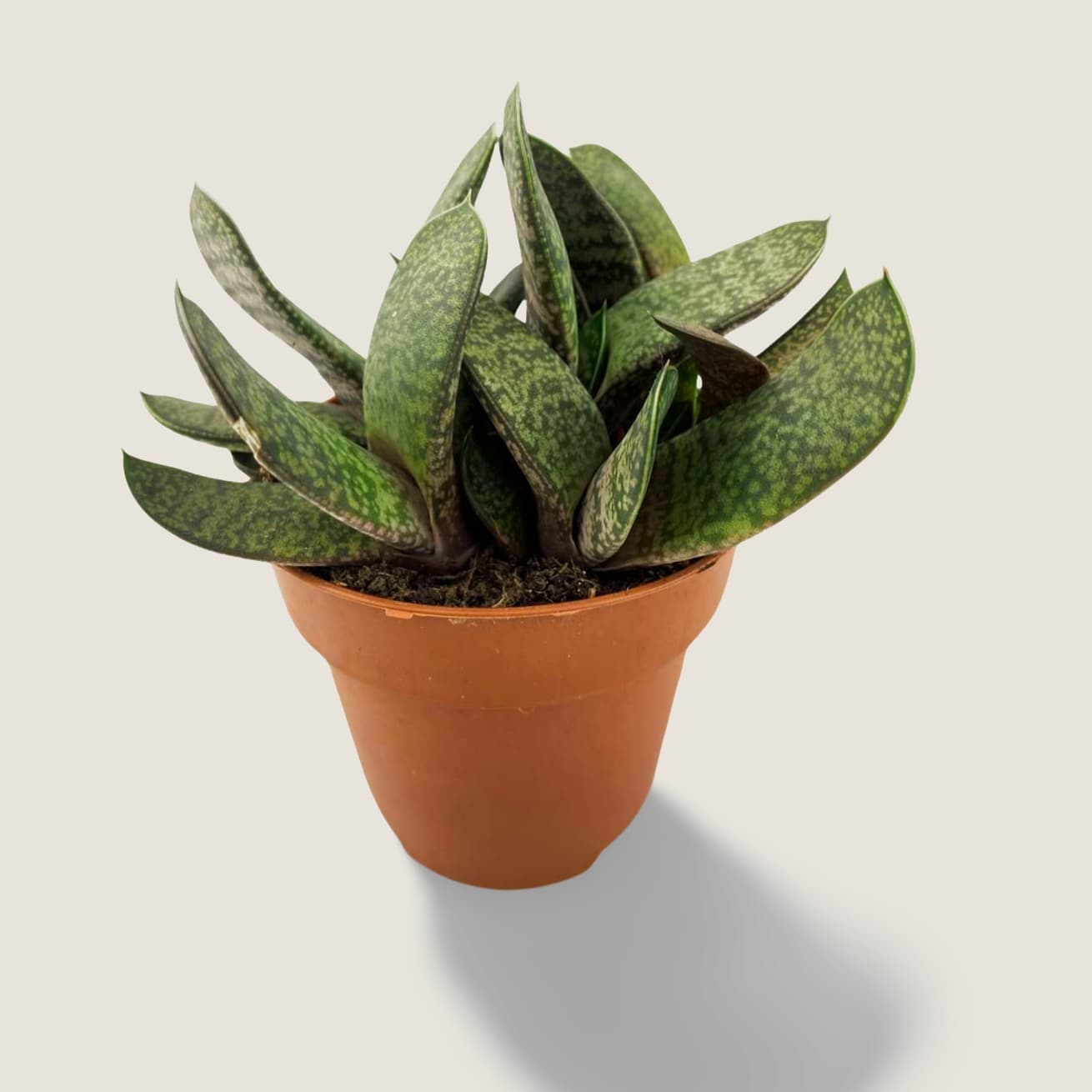
- Gasteria verrucosa, now treated botanically as a variety of Gasteria carinata (G. carinata var. verrucosa). Long triangular leaves entirely covered in white tubercles that feel like sandpaper. This is the classic old-fashioned Gasteria and one of the easiest plants you can own.
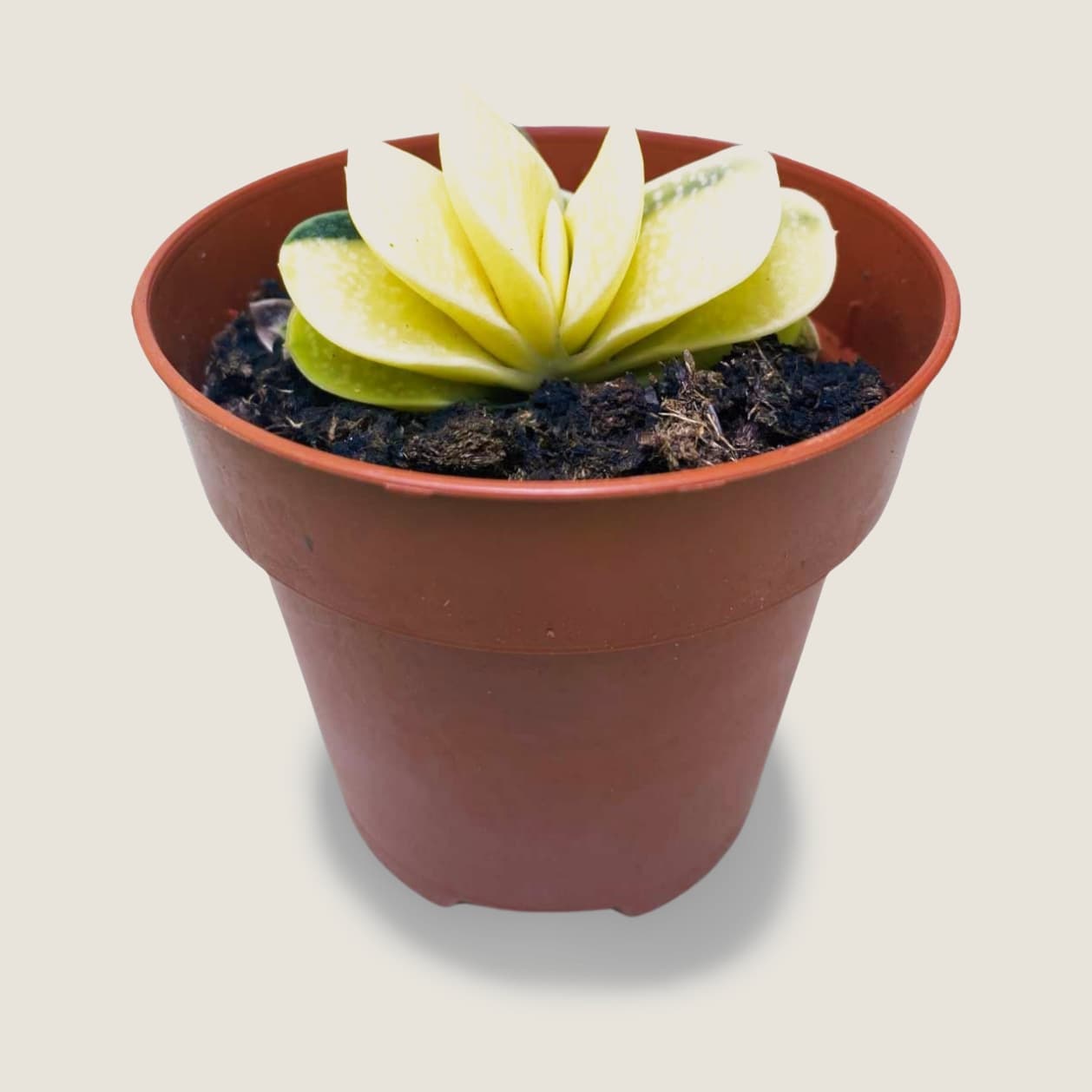
- Gasteria carinata variegata: the same species in its variegated form, with cream or yellowish bands where the tissue lacks chlorophyll. It grows more slowly than the green form and wants slightly less direct sun, since the pale sectors scorch first.
- Gasteria gracilis f. variegata: a small plant with short, strictly two-ranked leaves, long prized in Japanese collections where variegated forms have been selected for decades. Worth knowing that 'gracilis' is a widely used trade name for dwarf short-leaved forms, and its botanical placement is debated within the Gasteria bicolor complex.
Growing them
If one succulent was made for a northern European house, this is it. Because they live under bushes in the wild, they tolerate less light than almost any other succulent: an east- or north-facing window with bright but filtered light suits them perfectly. Direct midday summer sun scorches them and leaves permanent brown patches; gentle winter sun, by contrast, does them good. Under very strong light the leaves turn reddish and shorten — not fatal, but they lose their true colour.
Water sparingly: soak thoroughly, then let the compost dry right out, roughly every two or three weeks in spring and autumn and far less in midwinter. Water at the rim of the pot or from below, never over the plant; water trapped between the leaves or in the crown is the usual reason a Gasteria rots. The compost should be free-draining and largely mineral, though they take a little more organic matter than a cactus will. Protect them below 5 °C — outside the Mediterranean coast they are not winter-hardy outdoors.
They propagate themselves happily: offsets appear around the base and can be detached with their own roots, and Gasteria is one of the few Asphodelaceae that will root from a whole leaf cut cleanly and left to callus for a few days.
Common mistakes
- Putting them in full sun because they are succulents. The commonest error of all, and variegated plants pay for it within days.
- Watering from above and leaving water sitting between the leaves.
- An oversized pot with moisture-retentive compost: the roots suffocate long before the leaves show it.
What we have in stock
We offer Gasteria verrucosa, Gasteria carinata variegata and Gasteria gracilis f. variegata as plants of roughly 10 to 15 cm, chosen individually and shipped from Almería across Europe in protective packaging. They are long-lived, slow-growing and remarkably undemanding: if you want a succulent that copes with an indirectly lit room and only needs watering once a fortnight, this is the genus to start with.