Lithops
Lithops are the succulents that fool the eye best. Each plant is a single pair of fused, swollen leaves sitting half-buried in the ground, their flat upper faces patterned and coloured like the pebbles around them. The genus was described by Nicholas Edward Brown in 1922; the name joins the Greek words for stone and appearance. They belong to the family Aizoaceae and grow in arid parts of South Africa and Namibia, on quartz, shale and limestone flats where rain is scarce and strictly seasonal. That camouflage keeps grazing animals away: until they flower, living stones are hard to spot even when you are standing on them.
3 plants in Lithops
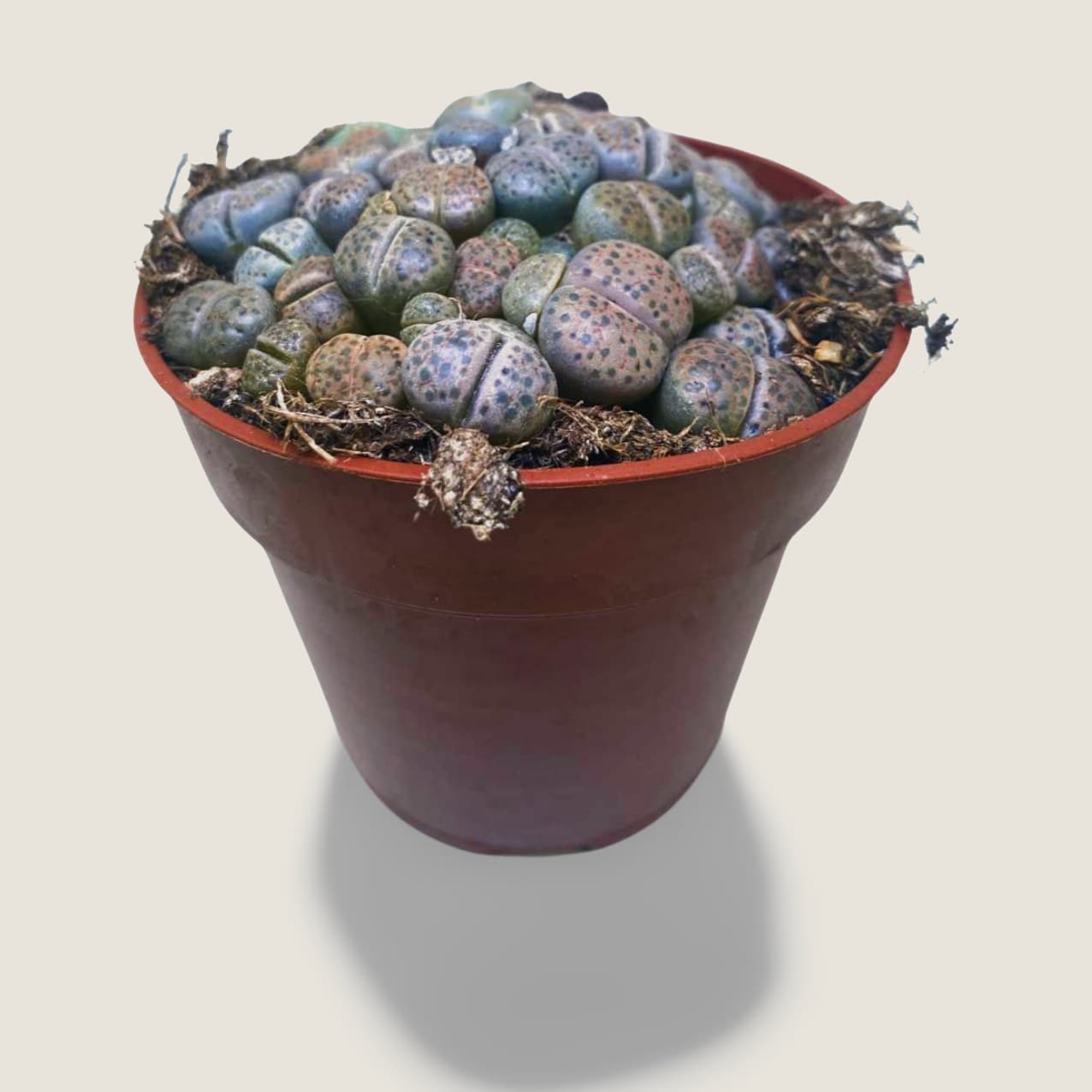
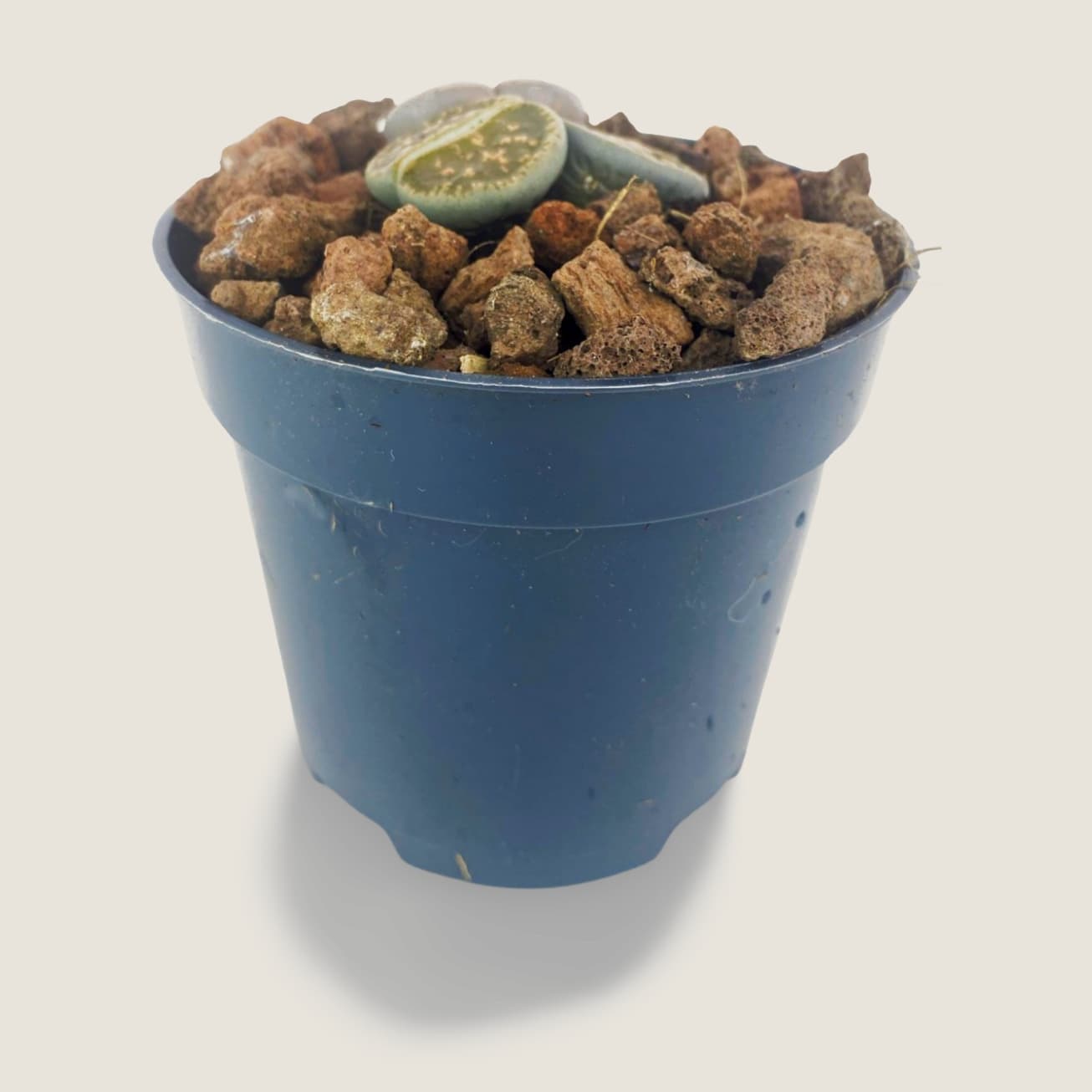
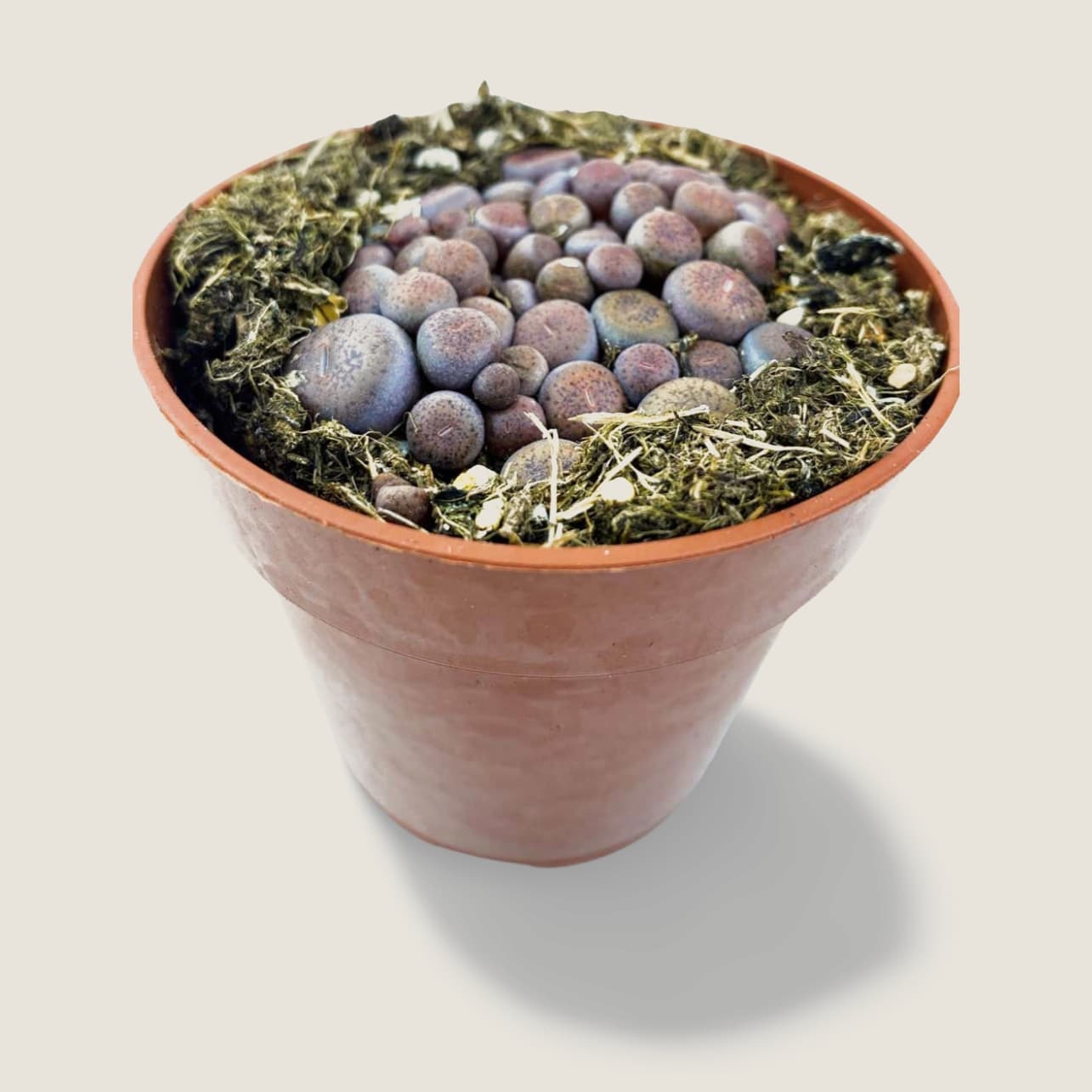
How a living stone is built
Understanding the anatomy prevents half the mistakes. The visible body is two leaves fused together and split by a fissure. The upper face is a window: a translucent epidermis that carries light down to the photosynthetic tissue inside, which sits below soil level. Underneath, the plant continues into a surprisingly long tap root. Two practical conclusions follow: the pot must be deep rather than wide (10 cm minimum), and the plant should sit with the fissure level with the top dressing.
The yearly cycle: when to water and when not to
Almost every Lithops that dies, dies of water — and nearly always water given in the wrong month. For the northern hemisphere the calendar runs like this:
- Autumn (September to November). Their season. A single daisy-like flower, white or yellow, pushes out of the fissure and opens in the afternoon. This is when watering makes sense: soak thoroughly, then let the compost dry out completely before repeating.
- Winter (December to February). Dormancy and leaf change. A new pair of leaves is forming inside the old one, living off its water and reserves. No water at all.
- Spring (March to May). The old leaves shrivel and dry into two papery skins on either side of the new body. Only once they are completely dry and loose can you water again, and lightly. Do not pull them off; if they will not come away by themselves, the change is not finished.
- Summer (June to August). Aestivation. Above 30 °C the plant simply stops. Little or no water — at most a small drink in the evening if the body wrinkles badly. Slightly shrivelled plants in late August are normal, not thirsty.
Why is watering during the leaf change so damaging? Because the new pair, instead of drawing on the old leaves, swells with the water you give it. The old leaves never dry out, the plant stacks two or three pairs on top of each other, the body distorts, and the neck — permanently damp and covered by dead tissue — rots. A Lithops will go months without a drink; it will not survive a week of excess. When in doubt, do not water.
Light, compost and cold
After watering, light is the second thing that kills them. They want full sun or the brightest south-facing windowsill you have. In poor light they etiolate: the body stretches into a column, loses its markings and never recovers its shape. If they are going outdoors, acclimatise them gradually.
The compost should be essentially mineral: pumice, coarse silica sand, grit or akadama, with no more than 10-20 % organic matter. Avoid peat, which stays wet for days. A top dressing of gravel keeps the neck dry and mimics the habitat. As for cold, kept bone dry they tolerate temperatures close to 0 °C; with damp compost, 5 °C is already risky. A cool, bright, dry winter is precisely what triggers the following season's flowers. Feed almost never: one very dilute low-nitrogen feed in autumn is plenty.
Telling the species apart
There are around forty accepted species and a great many local forms. They are separated by the pattern and colour of the top face, the transparency of the window, the depth of the fissure and the flower colour, which is a fairly reliable character. The ones you will meet most often in cultivation:
- Lithops lesliei: olive-brown face with a fine network of lines, yellow flower. One of the toughest.
- Lithops aucampiae: cinnamon to reddish tones, broad window, yellow flower. An excellent first Lithops.
- Lithops karasmontana: pale grey faces with brown or reddish channels, white flower. From the Karas mountains of Namibia.
- Lithops optica, especially the cultivar 'Rubra': violet bodies with very translucent windows and white flowers; a little more demanding, and grateful for midday shade.
- Lithops pseudotruncatella: the first species described in the genus, grey-brown and yellow-flowered.
Naming a plant with certainty when its origin is unknown is hard even for experienced growers; the serious reference are Desmond Cole's field numbers. It is also worth not confusing them with their neighbours: Pleiospilos looks like an oversized granite Lithops but produces several pairs of leaves, and Conophytum grows through the winter.
What we have in stock
We offer Lithops in two sizes, M and L, plus a mixed reference, Lithops Variedad, with assorted species and colour forms — ideal for starting a collection or planting several stones together in one bowl. Every plant is picked individually and shipped dry from Almería to anywhere in Europe. If this is your first one: deep pot, brightest window in the house, watering can out of reach until autumn.