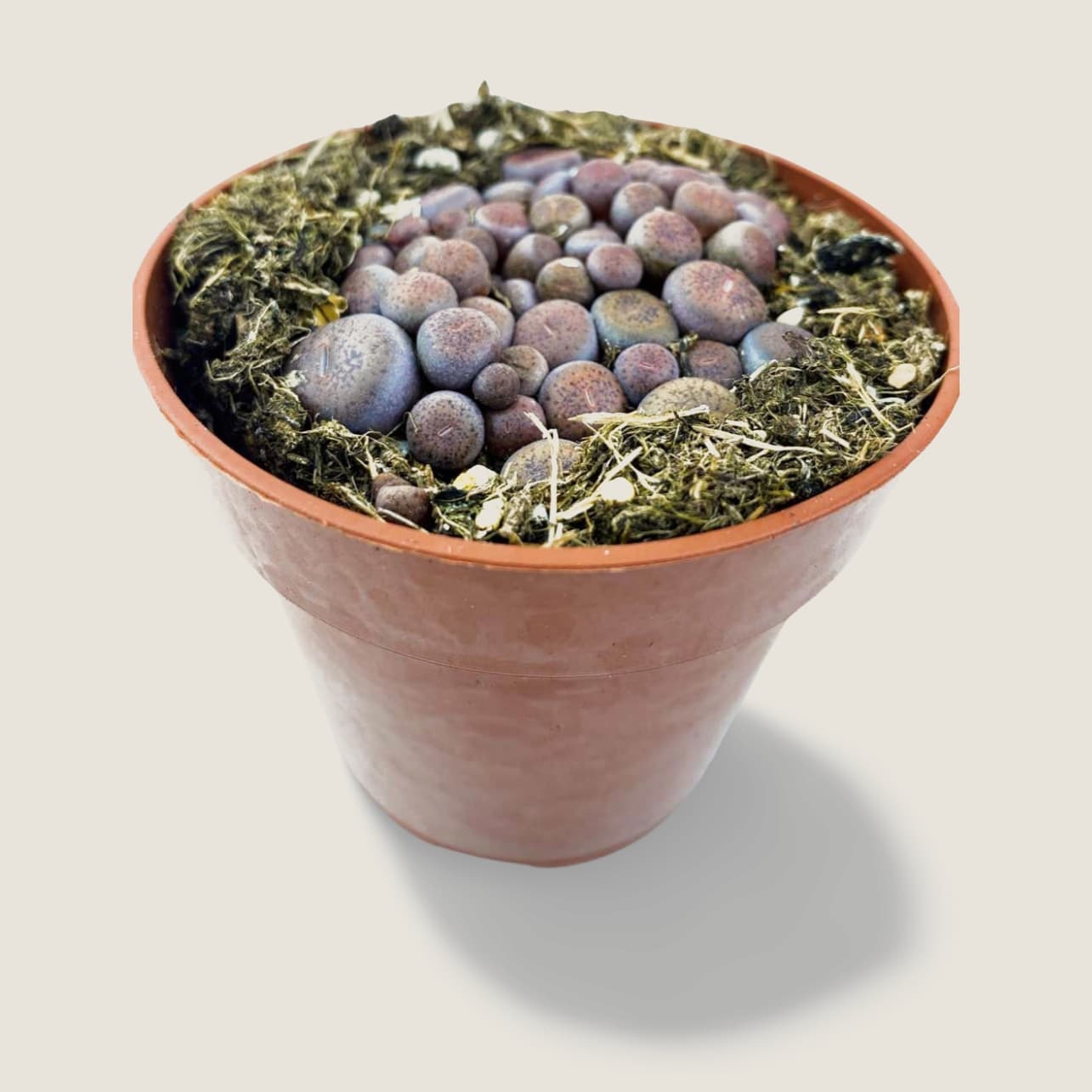
Lithops Variety
AizoaceaeLithops Variety · the «living stones»: the entire plant is two fused leaves imitating a pebble so as to go unnoticed. Sent as a mixed selection: the species and the face pattern vary with what is in cultivation at the time. Grown in 100 % mineral substrate and full sun at our nursery in Almería.
About Lithops Variety
Lithops are the «living stones». The whole plant is two fleshy fused leaves with a slit down the middle, and that is all there is: no stem, no branches, no new leaves at the sides. They live almost buried in the deserts of Namibia and South Africa, imitating the pebbles around them so grazing animals never find them.
The genus gathers some forty species and a great many more local forms, and each one carries its own pattern on the face: transparent windows, dots, branching lines, tones running from grey-green to reddish brown or almost violet. That is the reason people collect them.
These are sent as a mixed selection: species and pattern vary with what is in cultivation at any given time, so there is no choosing by colour. It is the cheapest way to gather several different patterns at once, and also the closest to how they turn up on the ground in the Karoo, mixed in with one another.
We grow them in 100 % mineral substrate and full sun at our nursery in Almería. That is what keeps the body low, the pattern on the face sharp and the plant compact — a Lithops raised in poor light stretches upwards and never goes back.
Botanical fact sheet
| Scientific name | Lithops sp. — the exact species varies with the batch | |
| Family | Aizoaceae | |
| Origin | Namibia and South Africa | |
| Natural habitat | stony plains and semi-deserts of the Karoo | |
| Adult size | 2-5 cm body depending on the species | |
| Flowering | white or yellow flower emerging from the slit, in autumn | |
| Propagation | seed | |
| Toxicity | not toxic |
Care
They renew their leaves once a year. A new pair pushes out of the centre and feeds on the old one, which shrivels until it is little more than paper. This is the plant's normal cycle, not a plant dying.
During that moult you do not water. At all. If you water, the old pair is never used up, the plant swells and ends up splitting or rotting. It is by far the number one cause of dead Lithops. Outside the moult, water sparingly: one soak, then let the substrate dry out completely before the next.
Direct sun and mineral substrate, no peat. In poor light they stretch upwards, lose the pattern on the face and never become compact again. Kept dry they take cold quite well; with damp substrate, they do not.
Did you know?
The pattern on the face is not decorative: it copies the particular soil of each population. Lithops growing on white quartz are pale, those growing on dark shale are brown, and a few kilometres apart the same species can look completely different. The camouflage matches the ground.
Luz
Full sun or very bright light
Riego
Very sparse; do NOT water during the leaf renewal (winter-spring) or in midsummer
Sustrato
100% mineral substrate, extremely free-draining
Temperatura
Protect below 5 °C and keep dry