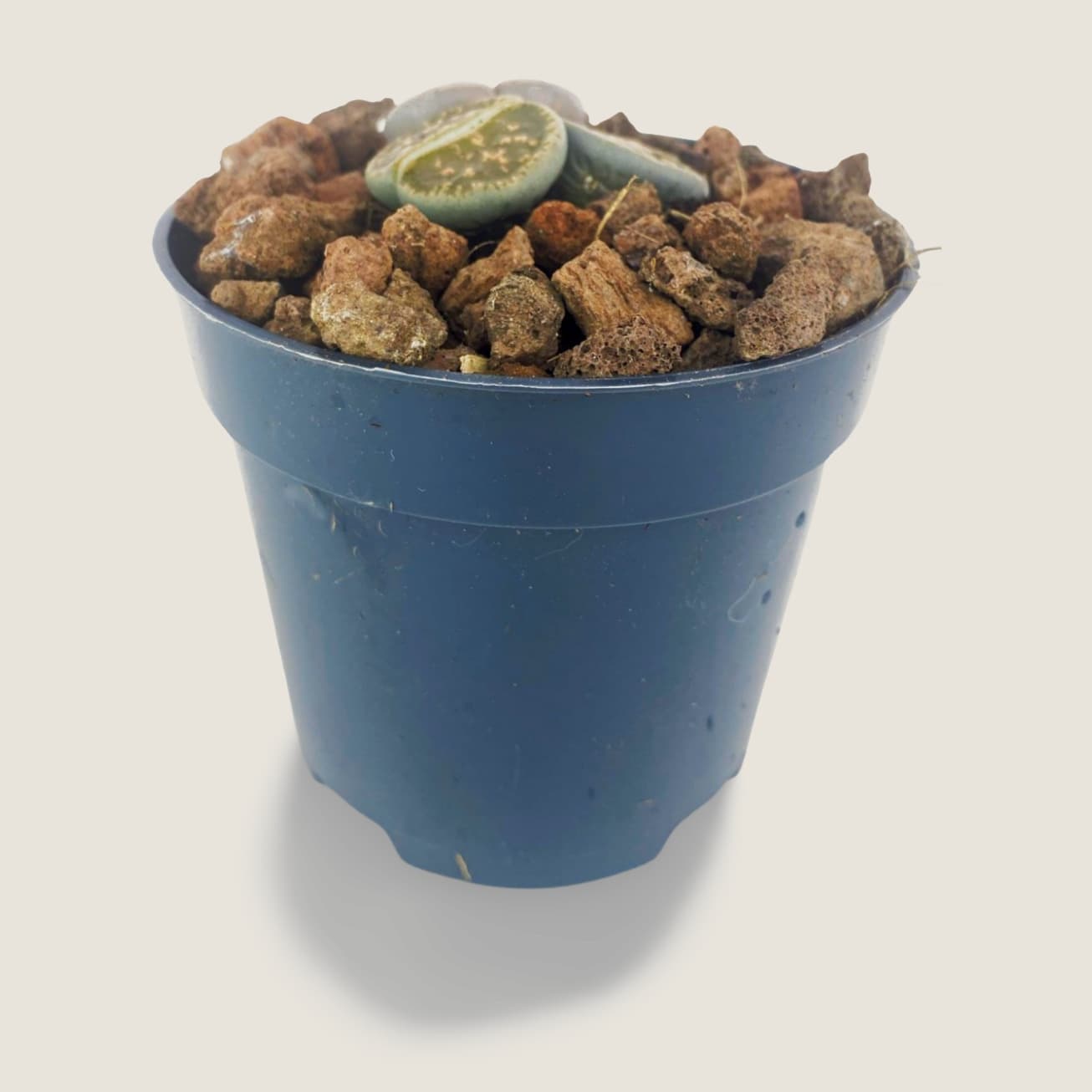
Lithops L
AizoaceaeLithops L · the «living stones»: the entire plant is two fused leaves imitating a pebble so as to go unnoticed. Size L: large specimens, with several moults behind them and often more than one head. Grown in 100 % mineral substrate and full sun at our nursery in Almería.
About Lithops L
Lithops are the «living stones». The whole plant is two fleshy fused leaves with a slit down the middle, and that is all there is: no stem, no branches, no new leaves at the sides. They live almost buried in the deserts of Namibia and South Africa, imitating the pebbles around them so grazing animals never find them.
Past a certain size the plant starts to divide: where there was one pair of leaves, two appear, and over the years a cluster of heads forms sharing a single root. That is also when flowering arrives — a white or yellow flower, wider than the plant itself, pushing out through the slit in autumn.
This is size L: large specimens, with several annual moults already behind them and frequently more than one head. They are the ones that flower soonest and the ones that best forgive a watering mistake, because they carry far more water in reserve than a young plant.
We grow them in 100 % mineral substrate and full sun at our nursery in Almería. That is what keeps the body low, the pattern on the face sharp and the plant compact — a Lithops raised in poor light stretches upwards and never goes back.
Botanical fact sheet
| Scientific name | Lithops sp. — the exact species varies with the batch | |
| Family | Aizoaceae | |
| Origin | Namibia and South Africa | |
| Natural habitat | stony plains and semi-deserts of the Karoo | |
| Adult size | 3-5 cm body in the L grade | |
| Flowering | white or yellow flower emerging from the slit, in autumn | |
| Propagation | seed | |
| Toxicity | not toxic |
Care
They renew their leaves once a year. A new pair pushes out of the centre and feeds on the old one, which shrivels until it is little more than paper. This is the plant's normal cycle, not a plant dying.
During that moult you do not water. At all. If you water, the old pair is never used up, the plant swells and ends up splitting or rotting. It is by far the number one cause of dead Lithops. Outside the moult, water sparingly: one soak, then let the substrate dry out completely before the next.
Direct sun and mineral substrate, no peat. In poor light they stretch upwards, lose the pattern on the face and never become compact again. Kept dry they take cold quite well; with damp substrate, they do not.
Did you know?
A well-kept Lithops lives for decades: there are collection plants over forty years old, and they are still the same size as they were at five. They do not grow upwards — every year they change leaves and stay exactly as they were. The only thing that gives their age away is the number of heads.
Luz
Full sun or very bright light
Riego
Very sparse; do NOT water during the leaf renewal (winter-spring) or in midsummer
Sustrato
100% mineral substrate, extremely free-draining
Temperatura
Protect below 5 °C and keep dry