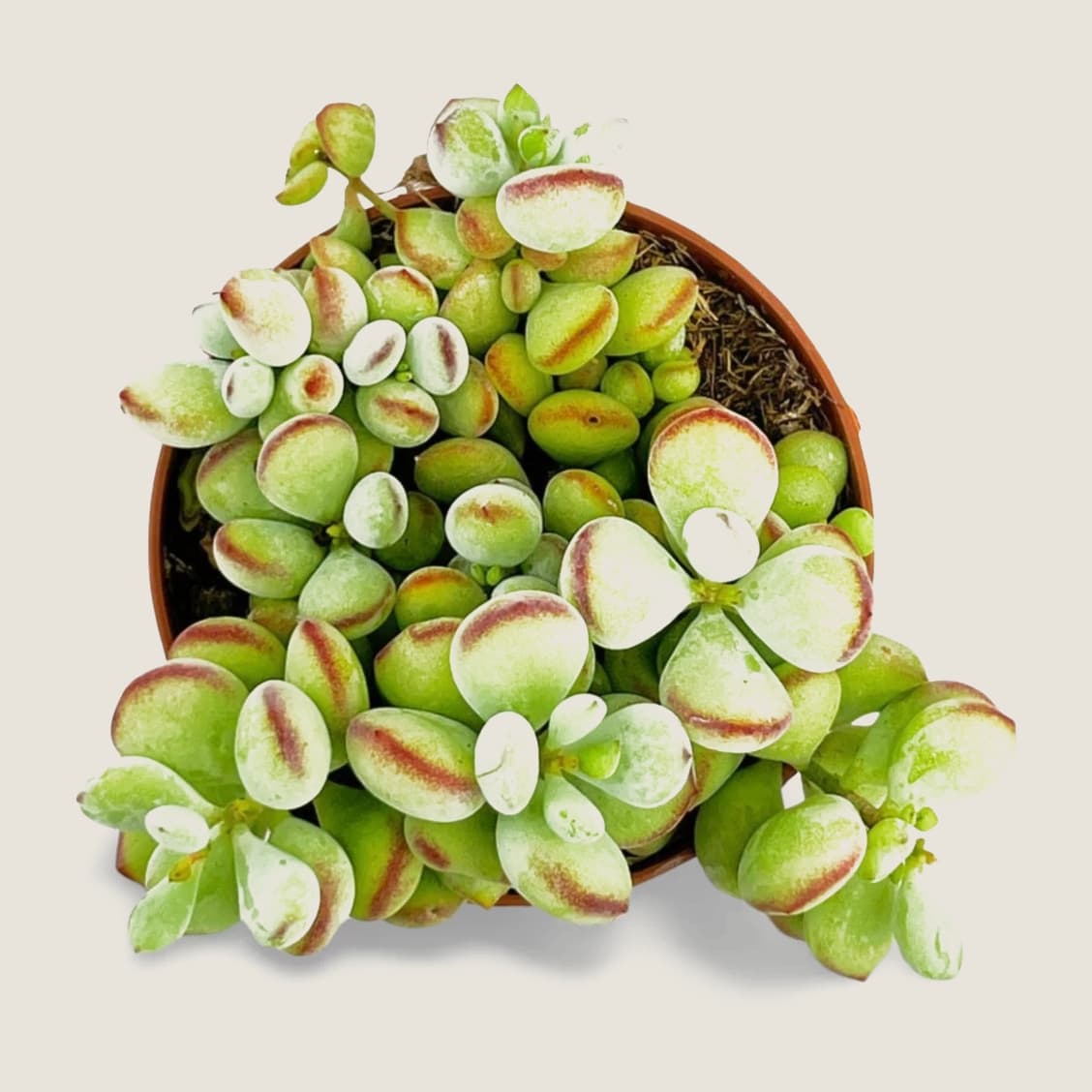
Cotyledon pendens
CrassulaceaeCotyledon pendens · a trailing plant with fat blue-green leaves and deep coral bells. Endemic to a single South African gorge: it grows wild nowhere else in the world. Grown in Almería.
About Cotyledon pendens
Trailing stems with thick, oval, blue-green leaves, often edged in red, hanging over the side of the pot for up to half a metre. It is one of the best trailing succulents there is, and a good deal less seen than a string of pearls or a burro's tail.
What finishes it off are the flowers: hanging bells of an intense orange coral, large in proportion to the plant, which appear in summer and last for weeks.
And it has an unusual history: it is endemic to a single gorge, that of the Bashee river in the South African Eastern Cape, where it grows clinging to rock faces. It was not described until the 1990s. Every plant of it in cultivation worldwide comes from that one population.
Botanical fact sheet
| Scientific name | Cotyledon pendens | |
| Family | Crassulaceae | |
| Origin | endemic to the Bashee river gorge, Eastern Cape (South Africa) | |
| Natural habitat | rock faces and ledges, hanging vertically | |
| Adult size | trailing stems 30-60 cm | |
| Flowering | hanging coral-coloured bells, in summer | |
| Propagation | stem cutting; let the cut dry before planting | |
| Toxicity | toxic if eaten — like the rest of the genus |
Care
Hang it. It grows downwards by nature, and in a pot standing on a surface the stems snap over the rim. It wants plenty of light but appreciates the harshest summer sun filtered — in its gorge it grows on a wall, in shade for part of the day.
Sparing watering, letting the substrate dry out completely; in winter, almost none. The fat leaves are its reservoir: if they wrinkle, it is thirsty; if they go soft and transparent, you have overdone it. Cuttings root easily, so it is simple to fill out the pot and make it denser.
Did you know?
A plant endemic to a single gorge means its entire world population fits into a few kilometres of rock face: one flood, one fire or one bout of mass collecting can take out the whole species. In cases like this, nursery growing stops being only commerce — it is the species' safety net.
Luz
Direct sun or very bright light
Riego
Sparse; let the substrate dry out between waterings
Sustrato
Very free-draining mineral substrate, specific for cacti and succulents
Temperatura
Protect below 5 °C