Haworthia
Haworthia is the collector's succulent par excellence: small rosettes only a few centimetres across, with fleshy leaves that in many species end in a translucent window through which light enters. They are endemic to South Africa, mainly the Eastern and Western Cape, and in habitat they grow almost buried among gravel or in the shade of shrubs, with just the leaf tips showing. That transparent epidermis carries light down to the photosynthetic tissue below ground — the same solution Lithops arrived at, in a completely unrelated family. The genus honours the British botanist Adrian Hardy Haworth and belongs to the Asphodelaceae, alongside Aloe and Gasteria.
3 plants in Haworthia
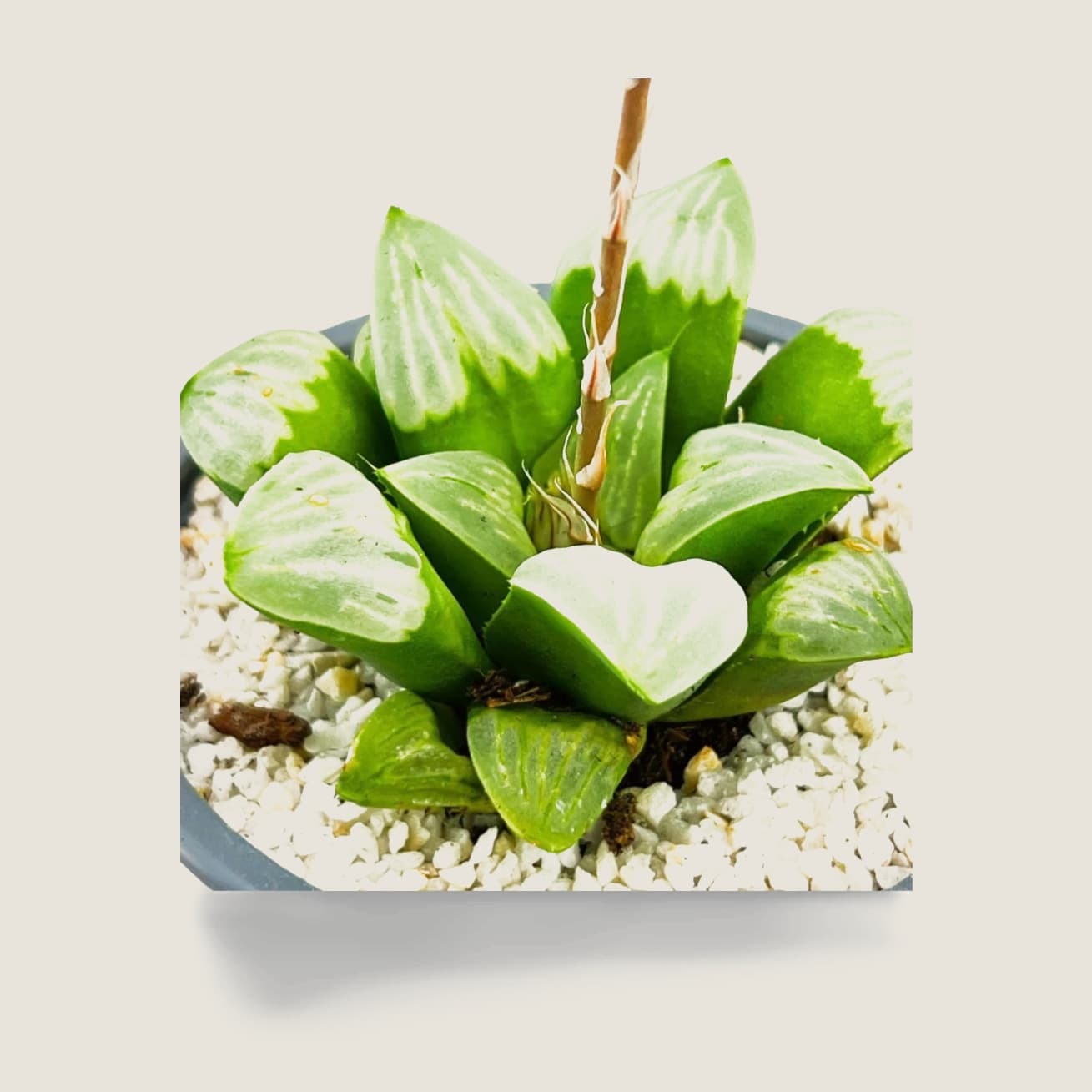
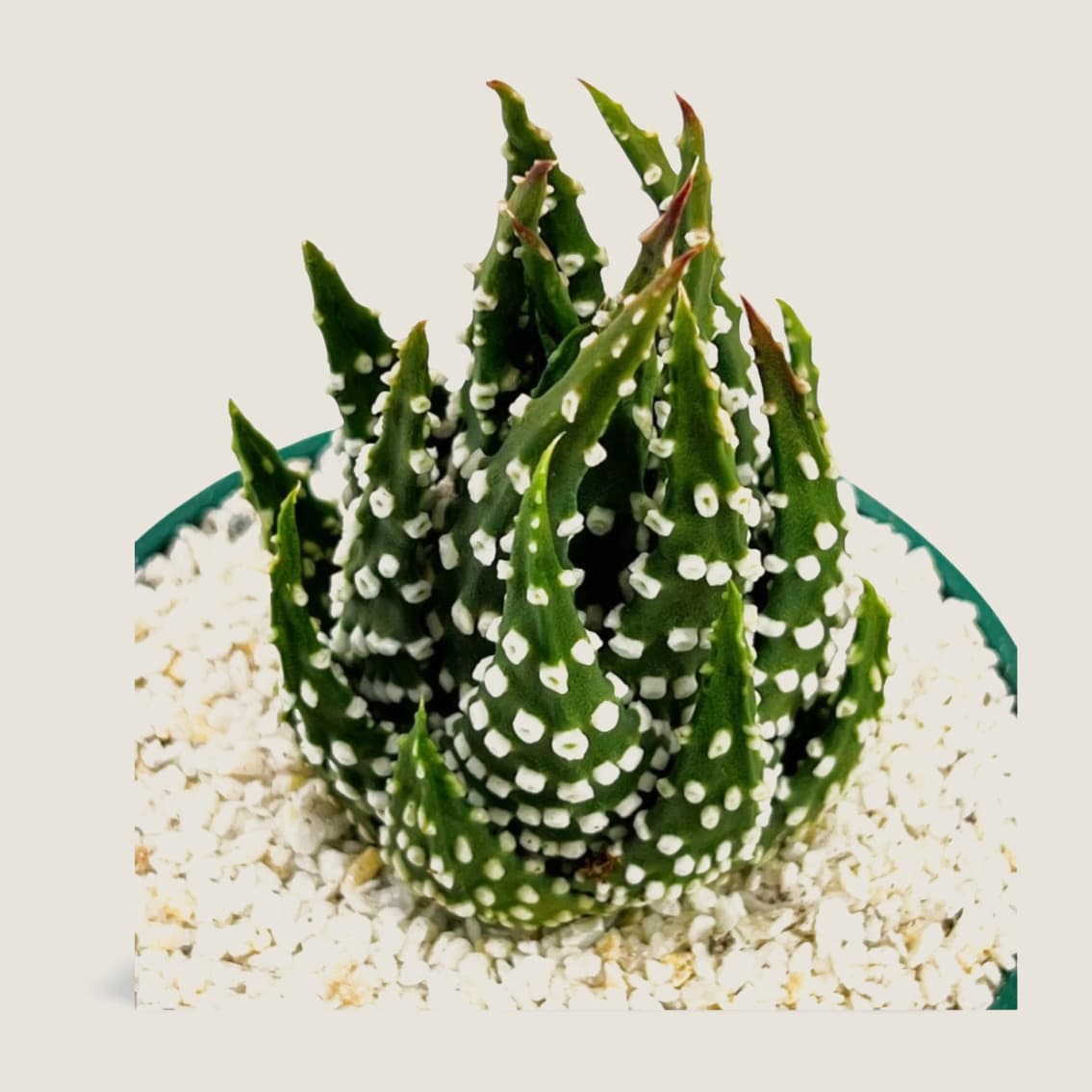
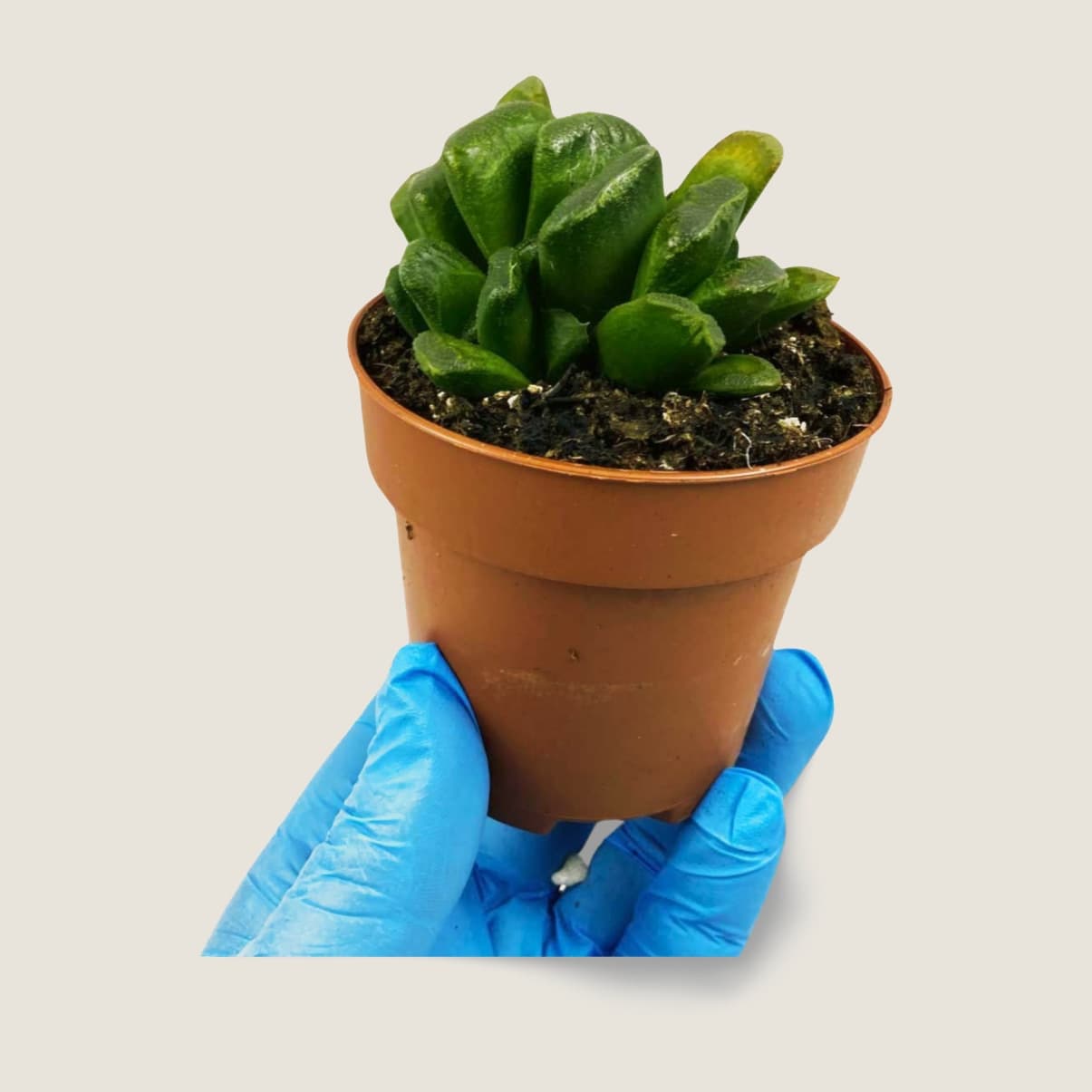
Haworthia, Haworthiopsis and Tulista
The naming needs untangling, because it affects what you are actually looking for. Molecular work split the old genus into three: Haworthia in the strict sense, with soft, turgid, often windowed leaves; Haworthiopsis, with hard, dark leaves covered in white tubercles (the former H. attenuata, H. fasciata and H. limifolia — the zebra plants); and Tulista, with large, robust rosettes. In our shop the soft-leaved plants sit in this category and the hard-leaved ones under Haworthiopsis.
The species we stock
- Haworthia truncata: the most extraordinary plant in the genus. Its leaves look as though someone sliced them off horizontally, and they line up in two opposite ranks like a flat fan. In the Little Karoo, near Oudtshoorn, it grows buried with only the truncated faces level with the soil. It is heavily collected in Japan, where clones are selected for leaf width and window pattern. It propagates from both leaf and root cuttings.
- Haworthia margaritifera: a historic name meaning 'pearl-bearing', for a robust rosette covered in white, pearly tubercles. Current botany places it in Tulista pumila, though the trade still sells it under the classic name. It takes considerably more sun than the windowed species.
- Haworthia byakuya: a Japanese cultivar with a compact rosette, turgid leaves with translucent tips and pale variegation, from the soft-leaved hybrid lines. Like all selected cultivars it does not correspond to any wild population — it is a horticultural plant, and one of the most sought after.
Care
Light. Bright but filtered. No direct midday sun: the windowed species scorch, close up and turn reddish brown. That stress colouring is not fatal, but they take months to green up again. An east-facing window, or a south-facing one behind a net curtain, is ideal.
Water. Light and infrequent, every ten to fifteen days in spring and autumn, which is when they actually grow: they pause both in high summer heat and in winter cold. Always at the rim of the pot or from below, never into the centre of the rosette. One detail that saves plants: when the leaves shrivel the instinct is to water more, but in Haworthia the cause is usually the opposite — rotted roots that can no longer absorb. Before adding water, lift the plant and check the root.
Compost and pot. A 70-80 % mineral mix (pumice, coarse sand, grit) with a little fibre or loam. The roots are thick and fleshy, renew themselves seasonally, and it is normal for old ones to dry off. Repot every two or three years in early spring and clean away the dead roots while you are at it.
Cold. Protect below 5 °C. Kept dry they take a little more, but cold plus damp is lethal. Indoors there is no issue; on a balcony they must come in for the winter except in mild coastal areas.
Common mistakes
- Too much sun, on the assumption that every succulent wants it.
- Water sitting in the centre of the rosette.
- Watering harder when the plant shrivels, without checking the roots first.
What we have in stock
We offer Haworthia truncata, Haworthia margaritifera and Haworthia byakuya as plants of roughly 10 to 15 cm, chosen individually and shipped from Almería across Europe. If you are after the hard-leaved white-banded plants, look under Haworthiopsis. These are small, slow, very long-lived succulents — perfect for a shelf beside a window, for anyone short of space, and for anyone starting to collect seriously.