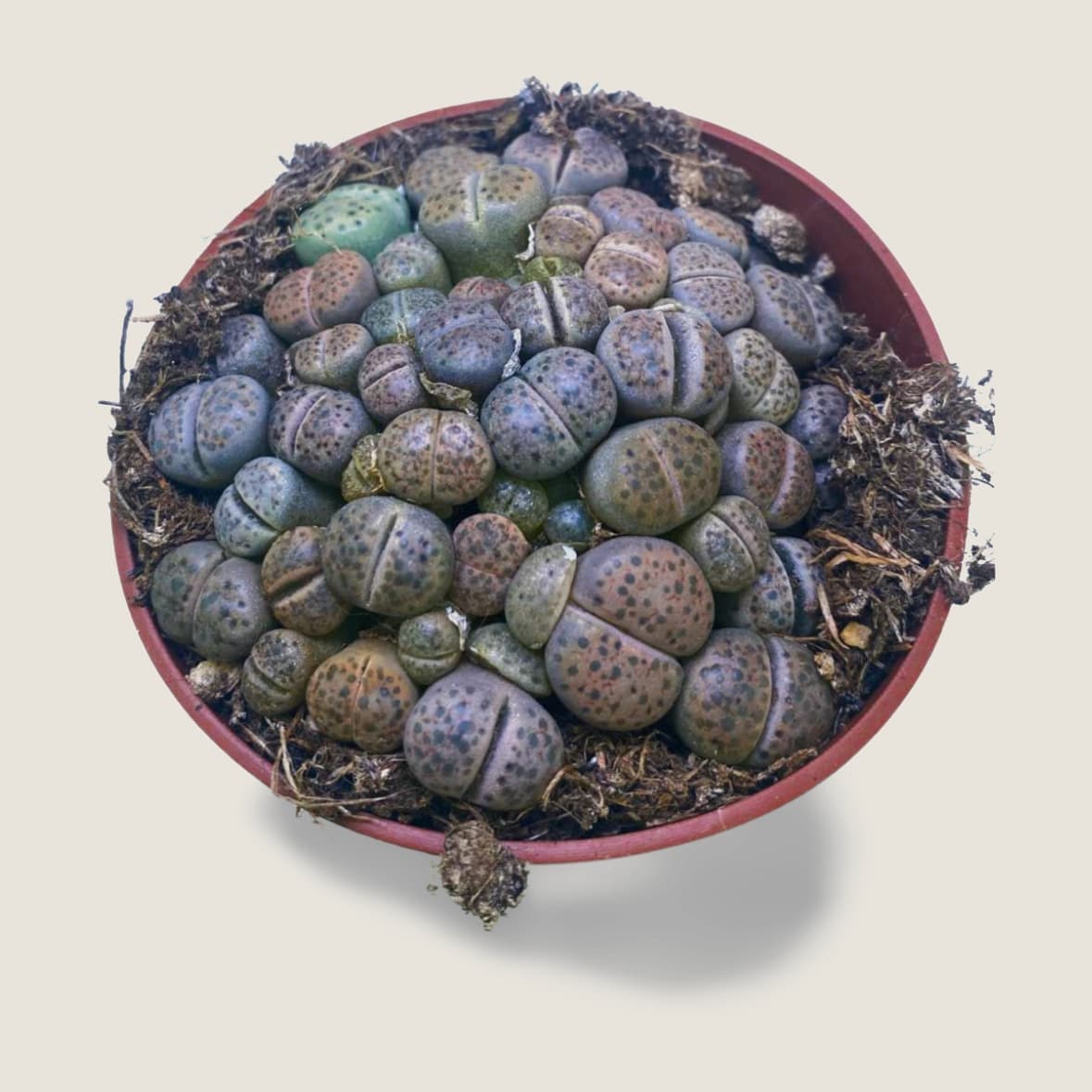
Lithops M
AizoaceaeLithops M · the «living stones»: the entire plant is two fused leaves imitating a pebble so as to go unnoticed. Size M: well-formed specimens with the face pattern already defined — the usual size to start a collection with. Grown in 100 % mineral substrate and full sun at our nursery in Almería.
About Lithops M
Lithops are the «living stones». The whole plant is two fleshy fused leaves with a slit down the middle, and that is all there is: no stem, no branches, no new leaves at the sides. They live almost buried in the deserts of Namibia and South Africa, imitating the pebbles around them so grazing animals never find them.
The upper face is translucent and works as a window: it lets light through into the inside of the leaf, where the photosynthetic tissue sits. That window is what allows them to live buried, sheltered from direct sun and from evaporation, without giving up light.
This is size M, the one we recommend for starting out: well-formed specimens, with a clearly drawn face and enough body not to suffer at the first repotting. From seed it takes two or three years to get to this point, and that is the stage with the highest losses — which is why we do not sell seedlings.
We grow them in 100 % mineral substrate and full sun at our nursery in Almería. That is what keeps the body low, the pattern on the face sharp and the plant compact — a Lithops raised in poor light stretches upwards and never goes back.
Botanical fact sheet
| Scientific name | Lithops sp. — the exact species varies with the batch | |
| Family | Aizoaceae | |
| Origin | Namibia and South Africa | |
| Natural habitat | stony plains and semi-deserts of the Karoo | |
| Adult size | 2-4 cm body in the M grade | |
| Flowering | white or yellow flower emerging from the slit, in autumn | |
| Propagation | seed | |
| Toxicity | not toxic |
Care
They renew their leaves once a year. A new pair pushes out of the centre and feeds on the old one, which shrivels until it is little more than paper. This is the plant's normal cycle, not a plant dying.
During that moult you do not water. At all. If you water, the old pair is never used up, the plant swells and ends up splitting or rotting. It is by far the number one cause of dead Lithops. Outside the moult, water sparingly: one soak, then let the substrate dry out completely before the next.
Direct sun and mineral substrate, no peat. In poor light they stretch upwards, lose the pattern on the face and never become compact again. Kept dry they take cold quite well; with damp substrate, they do not.
Did you know?
Their mimicry worked so well that the first botanists to cross the Karoo walked straight over them without seeing a thing. The first Lithops came to be described in 1811 because William Burchell bent down to pick up what he took to be an oddly shaped pebble.
Luz
Full sun or very bright light
Riego
Very sparse; do NOT water during the leaf renewal (winter-spring) or in midsummer
Sustrato
100% mineral substrate, extremely free-draining
Temperatura
Protect below 5 °C and keep dry