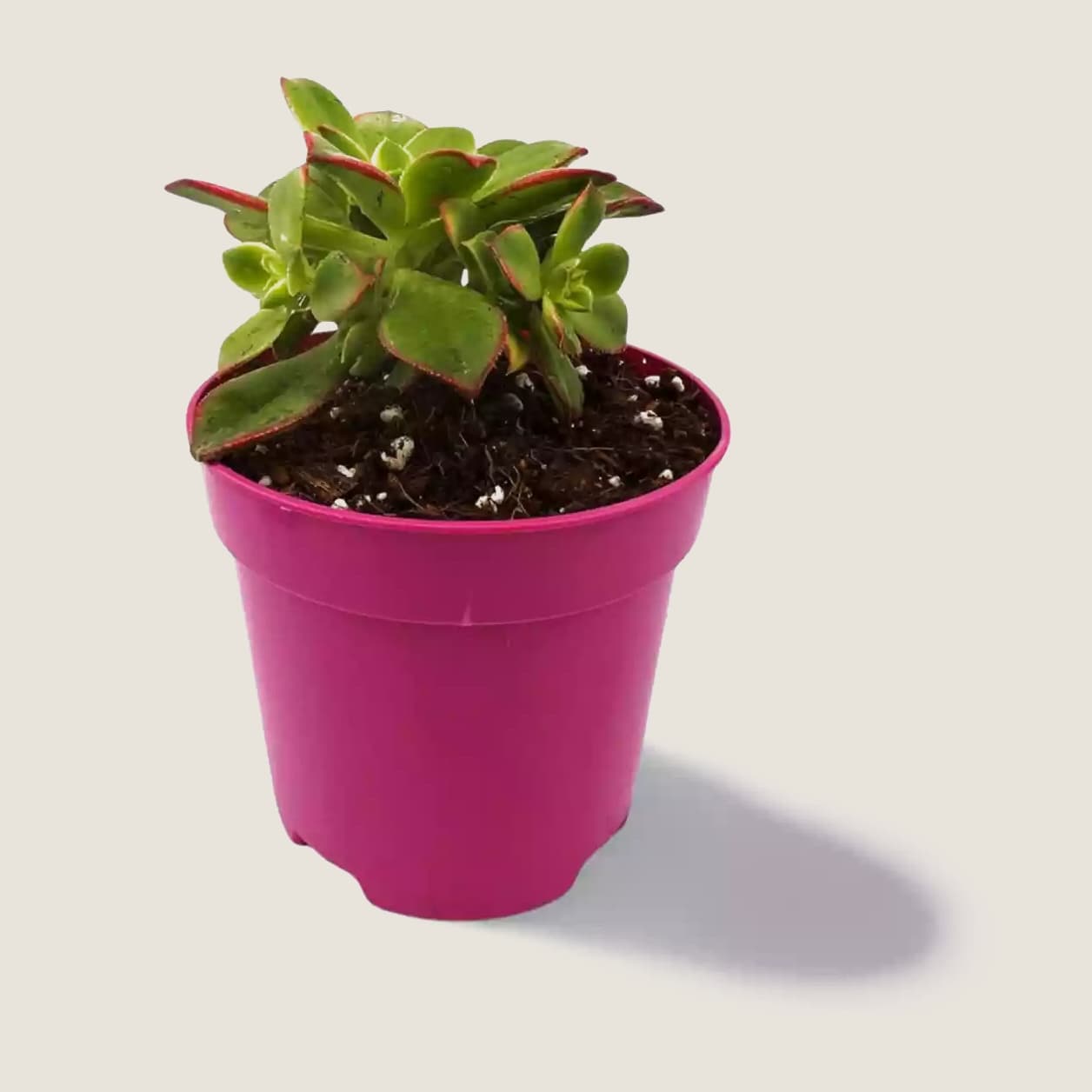
Aeonium 'Kiwi'
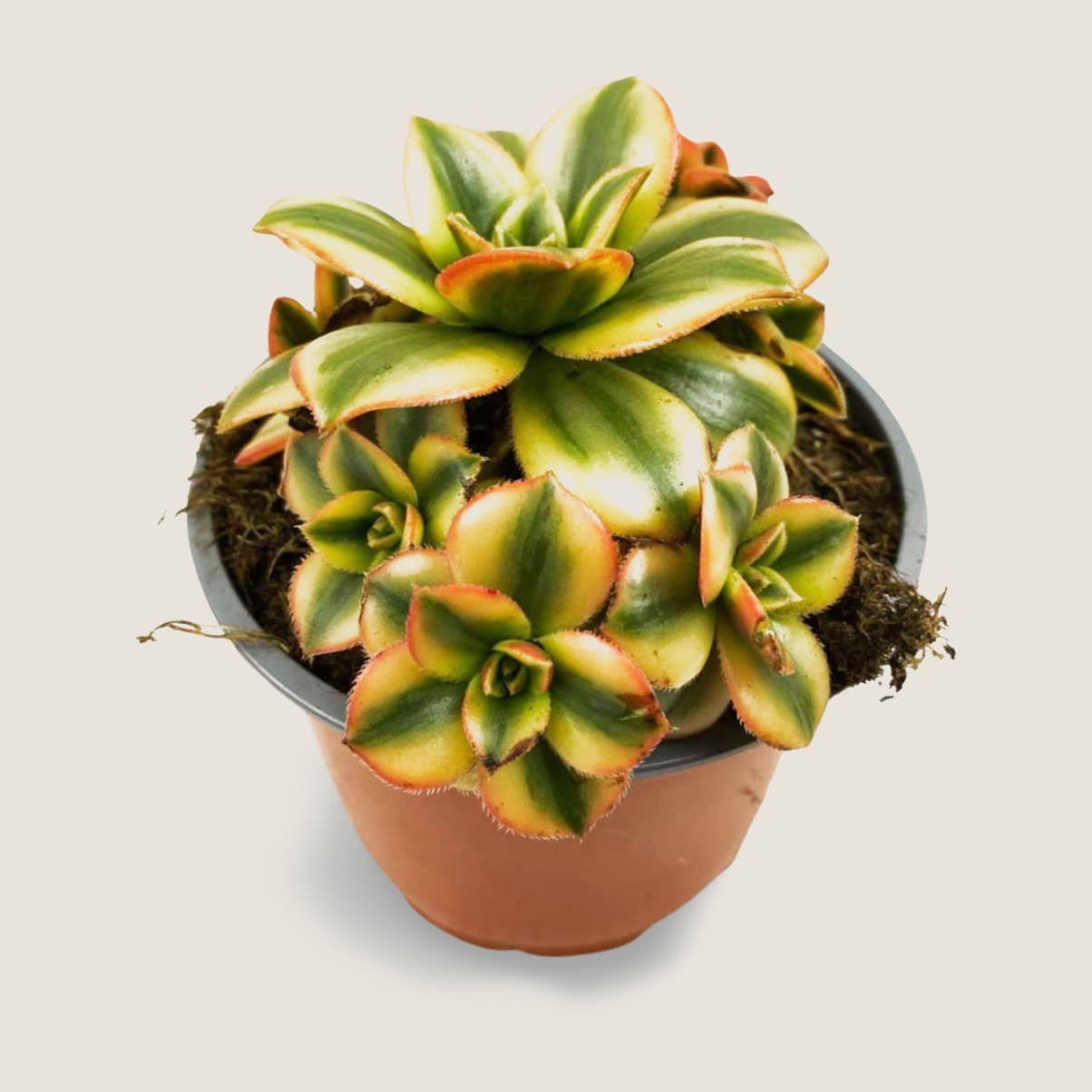
CrassulaceaeAeonium 'Kiwi' · rosettes with three colours at once: green in the centre, cream in between and a red edge when it gets sun. It grows in winter and rests in summer, the opposite of almost everything else. Grown in Almería.
About Aeonium 'Kiwi'
Flat rosettes with three colours at once: a bright green centre, a cream or pale yellow middle band and a red-tinged edge as soon as direct sun reaches it. It is a variety of Aeonium haworthii and is also sold as 'Dream Colour' or 'Tricolor'.
It branches from low down and over the years builds a small tree of woody stems with a rosette at each tip, up to half a metre. In a pot it stays a good deal more compact.
Aeoniums come from the Canary Islands and North Africa, from a Mediterranean climate, and that changes their care completely: they grow in autumn and winter and rest in summer, the exact opposite of almost every other succulent you may own.
Botanical fact sheet
| Scientific name | Aeonium haworthii 'Kiwi' | |
| Family | Crassulaceae | |
| Origin | garden variety; the species is endemic to Tenerife | |
| Natural habitat | cliffs and slopes in a Mediterranean climate | |
| Adult size | rosettes 8-12 cm; the plant, up to 50 cm | |
| Flowering | cluster of pale yellow flowers; that rosette dies afterwards | |
| Propagation | rosette cutting with a piece of stem | |
| Toxicity | not toxic |
Care
In summer it stops and closes its rosettes. The leaves bunch inwards and the outer ones dry and drop. That is normal dormancy, not thirst — and if you water to «save» it at that point, you rot it. Water properly in autumn and winter, which is when it grows.
It wants plenty of light to keep the three colours, but shade during the middle hours of summer: the cream band has no chlorophyll and scorches. Always water at the base, never over the rosette. And if it stretches and looks untidy, cut the head off with a few centimetres of stem, let the cut dry and replant it: it roots without trouble.
Did you know?
The genus Aeonium is a textbook case of island evolutionary radiation: from a single ancestor that reached the Canaries, some thirty-five species diversified across the islands, each adapted to its altitude and aspect. It is the same phenomenon that made Darwin's finches famous, but with succulents and in the Atlantic.
Luz
Gentle direct sun or bright partial shade
Riego
Moderate; they grow in autumn-winter and rest in summer
Sustrato
Very free-draining mineral substrate, specific for cacti and succulents
Temperatura
Protect below 5 °C