Euphorbia gorgonis
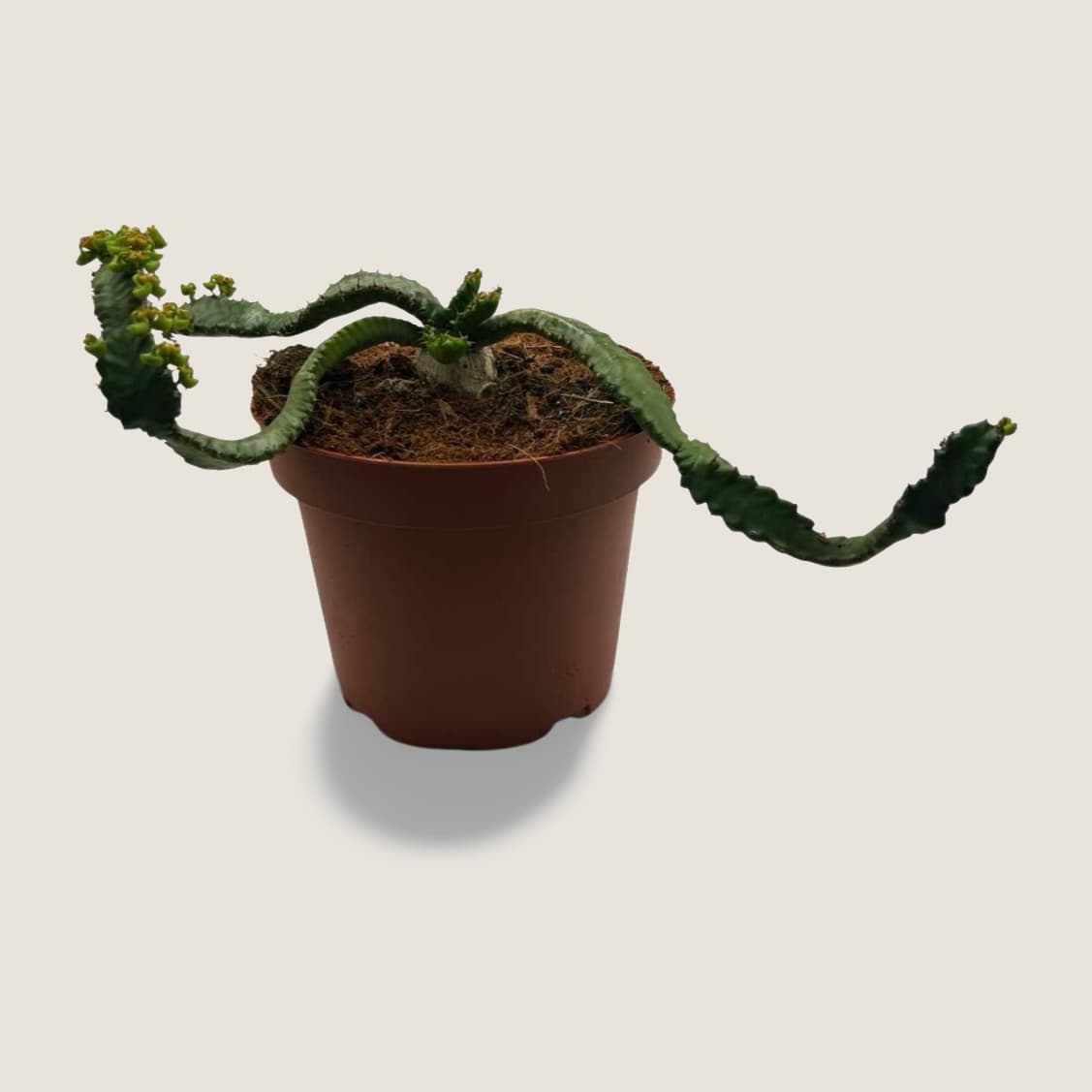
EuphorbiaceaeEuphorbia gorgonis · the «medusa's head»: a flattened central body from which dozens of tubercled arms radiate in every direction. Endemic to the South African Eastern Cape. Grown in full sun in Almería — the specimen in the photo is the one you receive.
About Euphorbia gorgonis
It is known as the medusa's head, and one look explains the name: a flattened central body, half buried, from which dozens of cylindrical arms covered in tubercles sprout in every direction. The epithet gorgonis comes precisely from the Greek gorgons, the ones with snakes for hair.
It is not a big plant. An adult specimen rarely gets past 15 cm across, and reaching that takes years because it grows slowly. This is a table plant, one to look at close up, not one to fill a corner with. And it is endemic to the South African Eastern Cape: in the wild it grows nowhere else on earth.
We grow it outdoors in Almería, and that is exactly what keeps the arms short and pressed against the body. It is the most visible difference between a sun-grown specimen and a greenhouse one.
Botanical fact sheet
| Scientific name | Euphorbia gorgonis | |
| Family | Euphorbiaceae | |
| Origin | endemic to the Eastern Cape, South Africa | |
| Natural habitat | dry stony ground of the Albany thicket | |
| Adult size | 10-15 cm across | |
| Flowering | yellowish-green cyathia on short stalks | |
| Propagation | seed | |
| Toxicity | irritant white latex |
Care
Wide, shallow pot. It grows outwards and its roots are shallow: in a deep pot the bottom stays wet, and that is where the trouble starts. Mineral substrate, very spaced-out watering letting it dry out completely in between, and virtually none in winter.
It needs direct sun. In poor light the arms stretch, pull away from the body and the plant loses the compact shape that is the whole point of it — and once stretched they never go back. It does not take frost: below 8 °C, bring it under cover.
Did you know?
The «medusa's head» shape has appeared several separate times within the same genus: Euphorbia caput-medusae, flanaganii, esculenta and this one all arrived at it independently. That is convergent evolution between close relatives, rather less common than it sounds.
Luz
Direct sun or very bright light
Riego
Sparse: let the substrate dry out between waterings; reduce in winter
Sustrato
Very free-draining mineral substrate, specific for cacti and succulents
Temperatura
Protect below 8-10 °C (cold-sensitive)