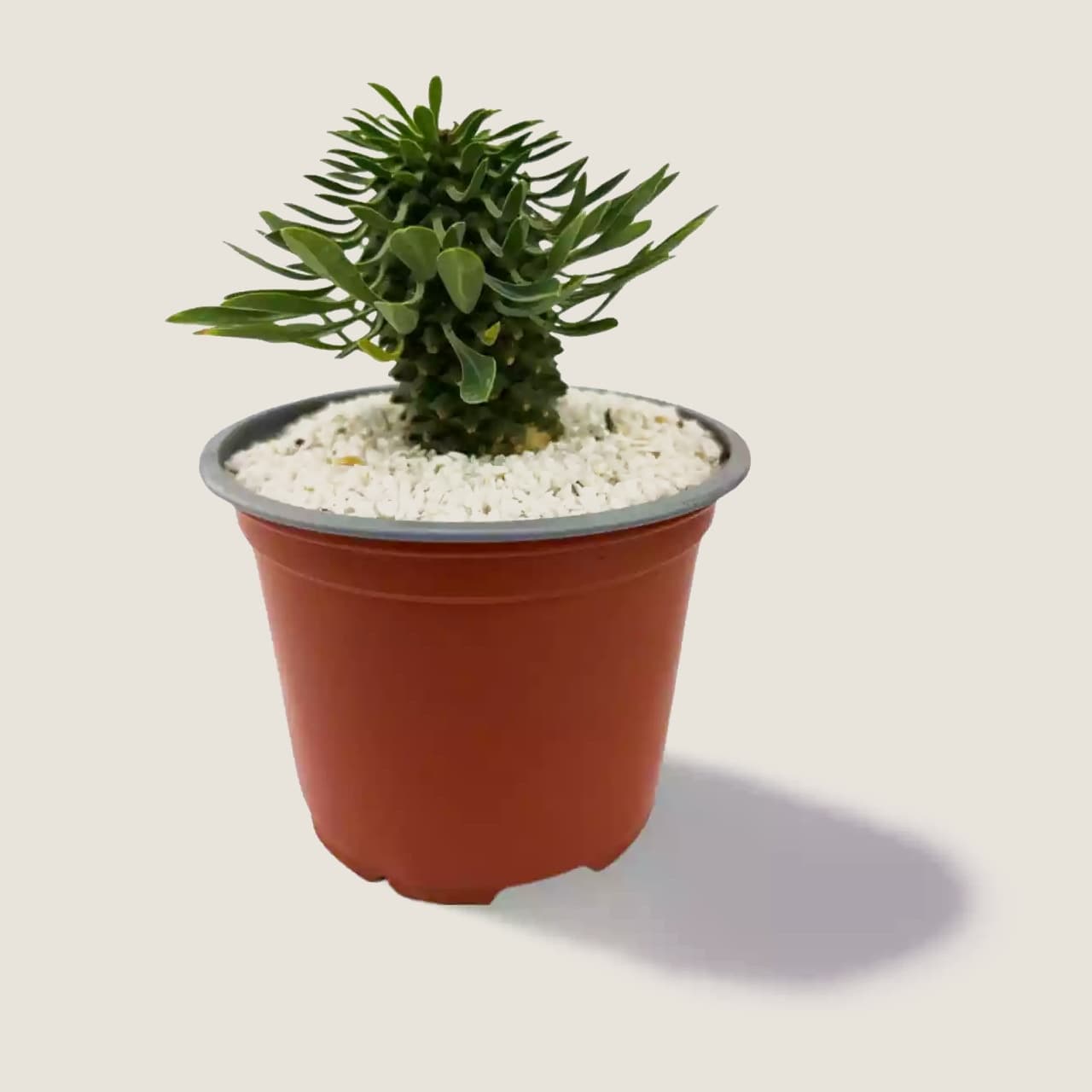
Euphorbia Sotetsu Kirin
EuphorbiaceaeEuphorbia Sotetsu Kirin · the Japanese name for Euphorbia bupleurifolia: a short trunk covered in tubercles, topped by a crown of narrow leaves, exactly like a miniature cycad. Grown in full sun at our nursery in Almería — the specimen in the photo is the one you receive.
About Euphorbia Sotetsu Kirin
Sotetsu kirin is the name given in Japan to Euphorbia bupleurifolia, and it describes exactly what you see: sotetsu is the sago palm, Cycas revoluta. The plant builds a short, thick trunk entirely covered by the tubercles left behind by fallen leaves, and finishes it off with a crown of narrow leaves. The likeness to a tiny palm is total, which is why many collectors simply ask for Euphorbia kirin.
It is one of the most sought-after euphorbias in the genus, and not because of fashion: that trunk takes years to build, the plant hardly branches and it grows very slowly. A specimen with real body has a long time behind it, and it rarely gets past 20 cm.
We grow it outdoors at our nursery in Almería, in the sun and the dry air of south-east Spain. The plant you receive was raised in the open and not in a heated greenhouse: compact trunk, short leaves, and roots used to mineral substrate.
Botanical fact sheet
| Scientific name | Euphorbia bupleurifolia | |
| Family | Euphorbiaceae | |
| Origin | Eastern Cape, South Africa | |
| Natural habitat | stony slopes and dry grassland | |
| Adult size | 10-20 cm tall | |
| Flowering | small cyathia on short stalks, in spring | |
| Propagation | seed; it produces almost no offsets | |
| Toxicity | irritant white latex |
Care
It drops its leaves when dormant, and that is completely normal. As temperatures fall it is left with a bare trunk until the following spring. This is where most people kill it: the bare plant reads as thirst, it gets watered, and the collar of the trunk rots.
In growth, water only when the substrate is bone dry; at rest, practically never. It wants plenty of light, but it appreciates shade during the middle hours of summer if it comes out of a greenhouse. Use 100 % mineral substrate and a pot that dries fast: its weak point is always the base of the trunk.
Did you know?
The kirin in its name is the Japanese mythological beast, the counterpart of the Chinese unicorn; in Japan the term is applied to several euphorbias of strange habit. And although it looks like a miniature cycad, it is not related to one at all: cycads are gymnosperms, closer to conifers than to this plant.
Luz
Direct sun or very bright light
Riego
Sparse: let the substrate dry out between waterings; reduce in winter
Sustrato
Very free-draining mineral substrate, specific for cacti and succulents
Temperatura
Protect below 8-10 °C (cold-sensitive)