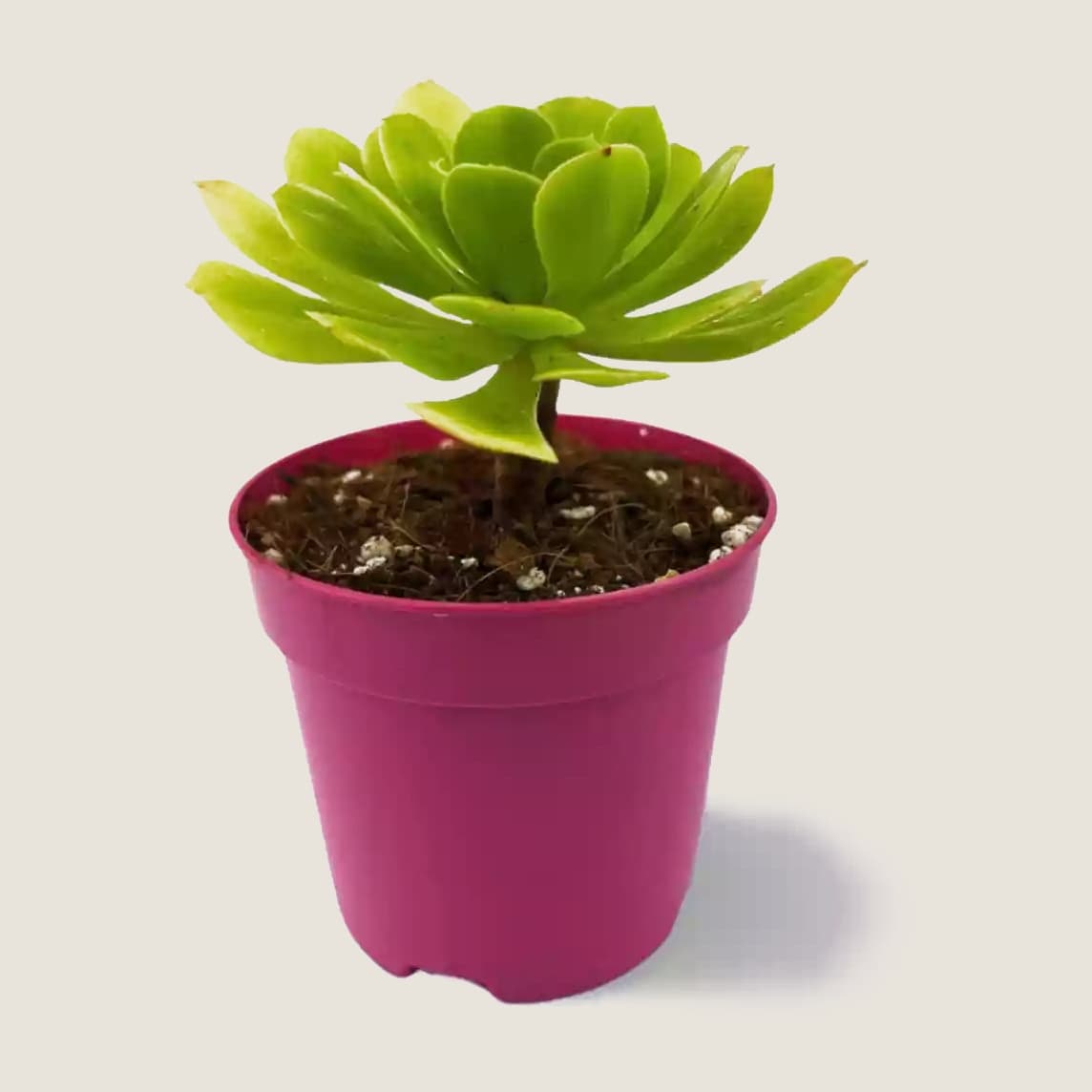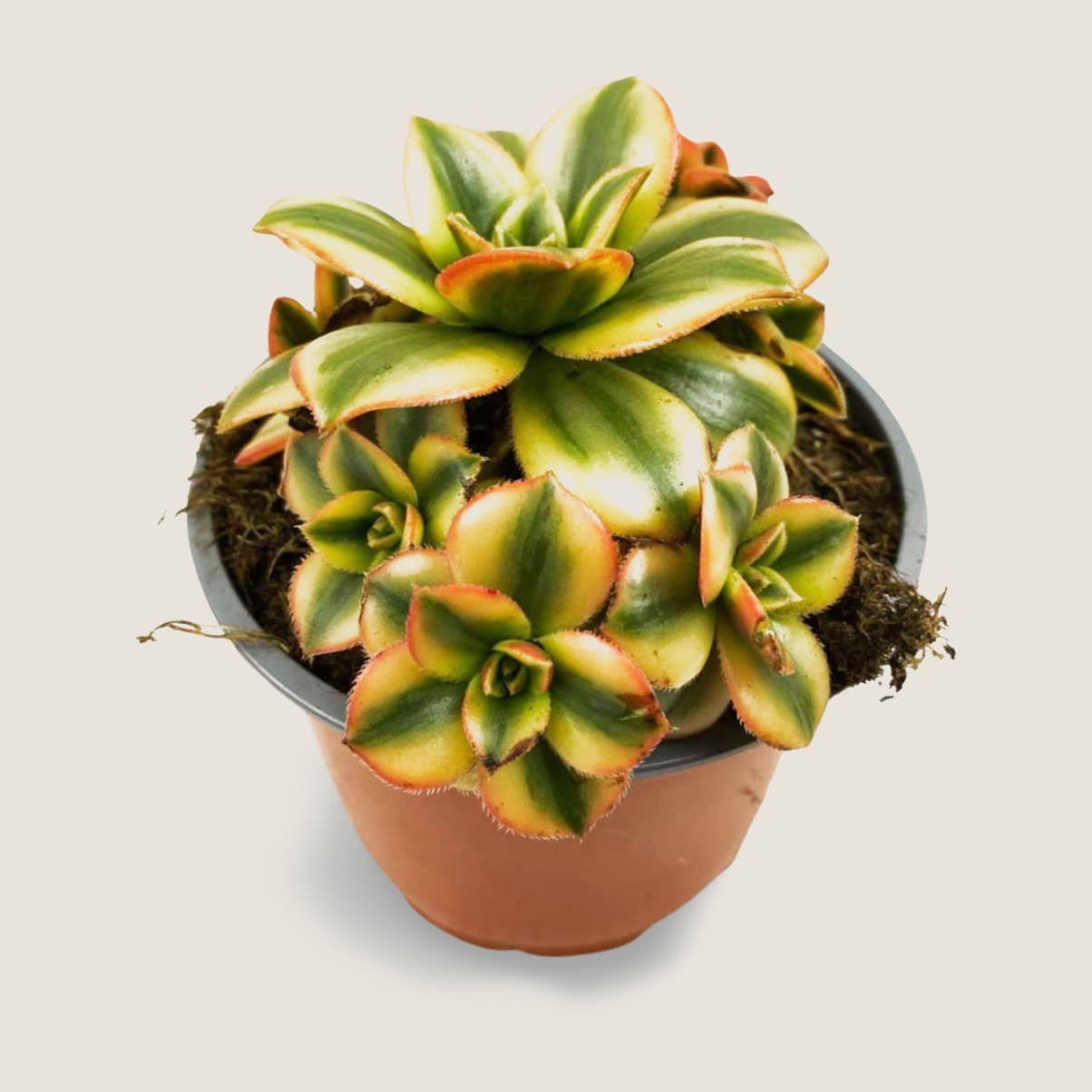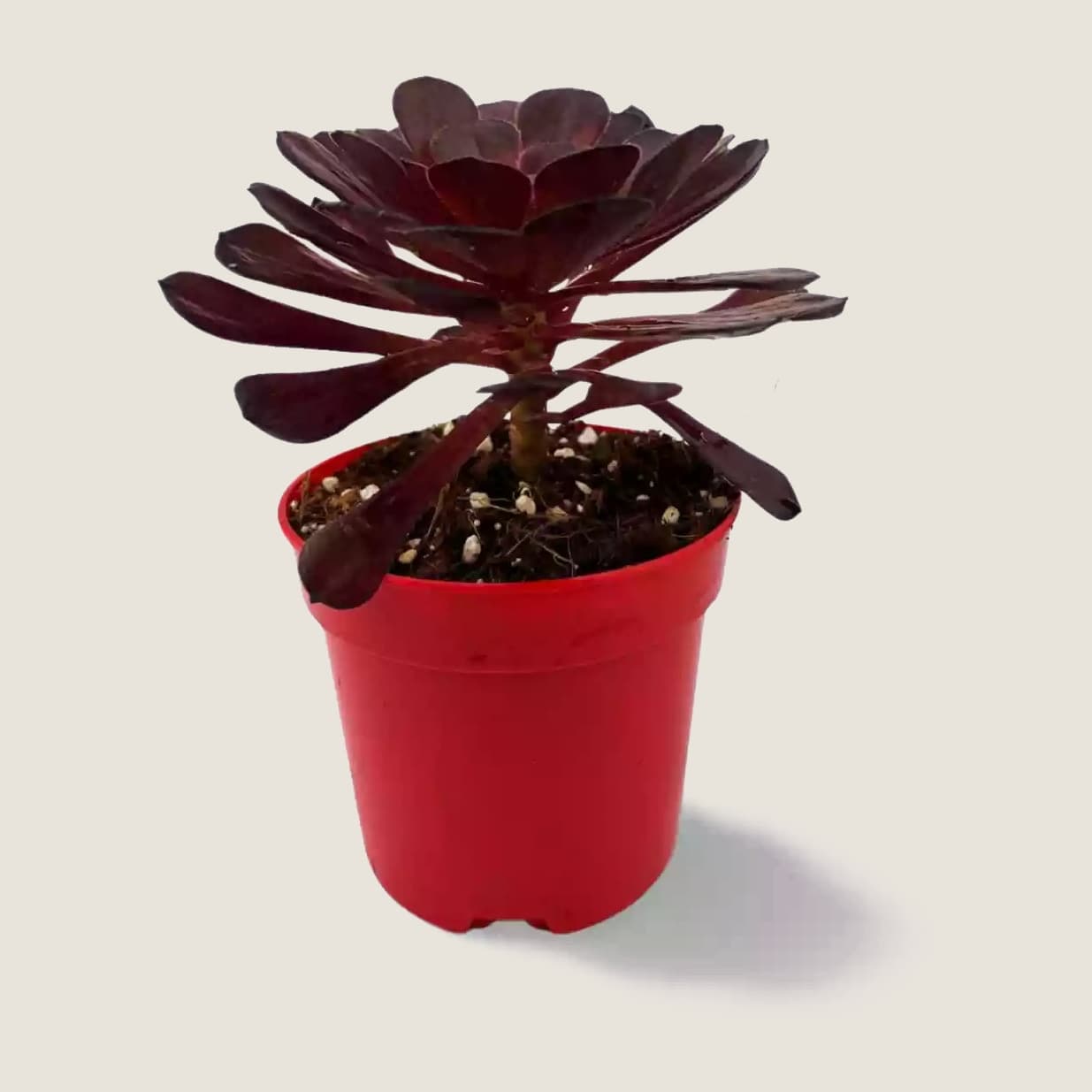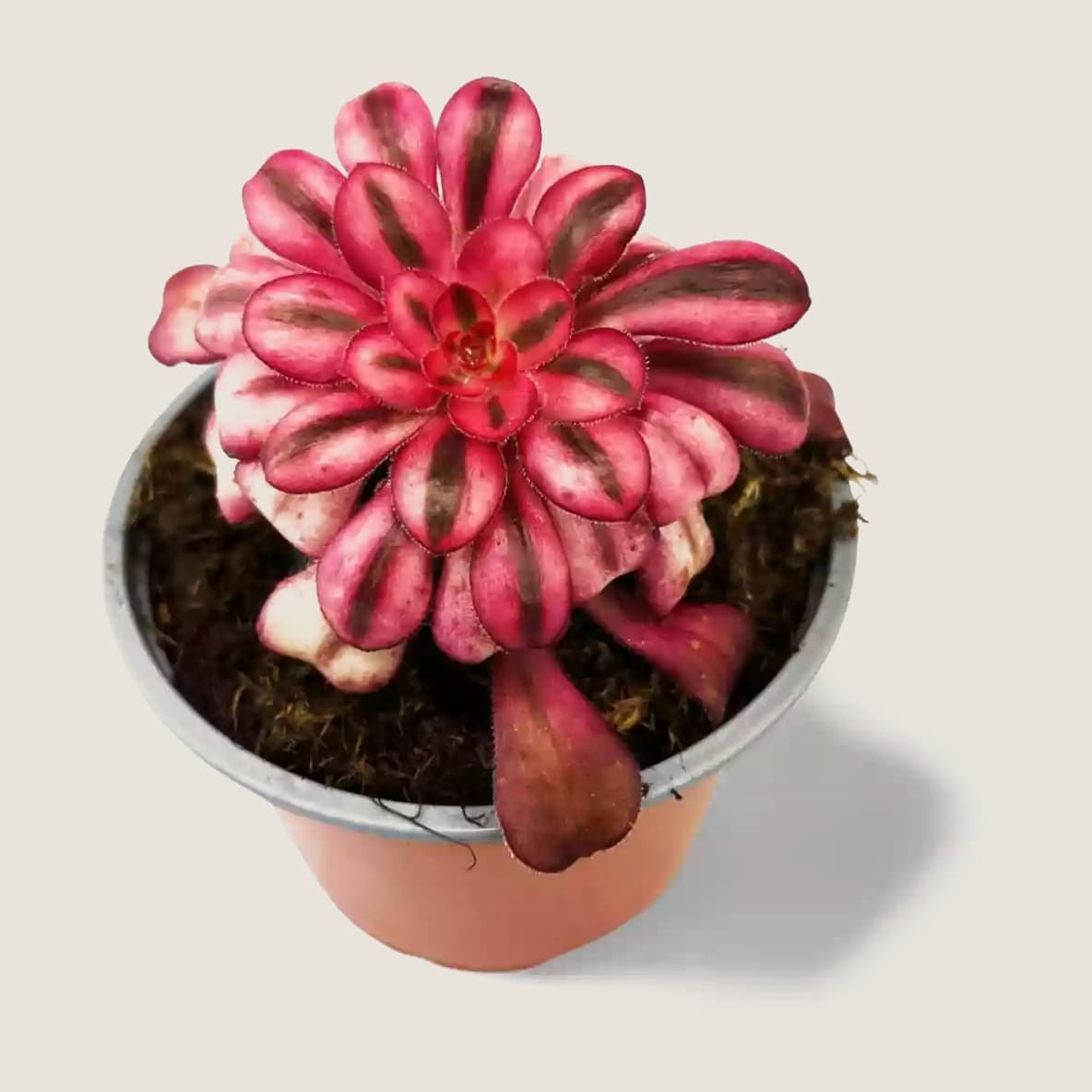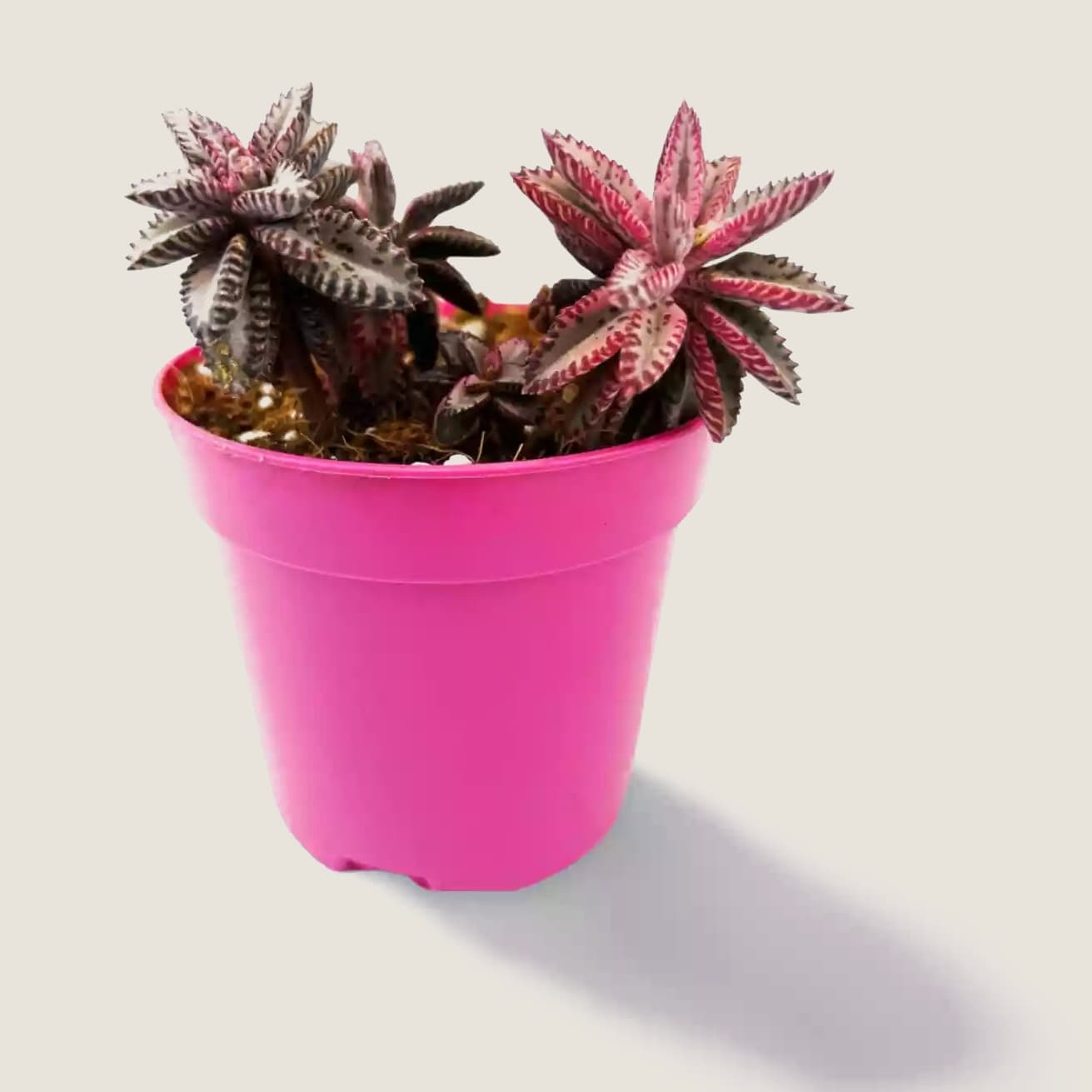
Pink Butterfly Kalanchoe
CrassulaceaeKalanchoe Pink Butterfly · the pink version of «mother of thousands»: rows of pink plantlets lined up along the edge of every leaf. Having no chlorophyll, they never root — which is why, unlike the common form, it does not turn invasive.
About Pink Butterfly Kalanchoe
This is the variegated form of the hybrid Kalanchoe × houghtonii, the famous mother of thousands. Along the edge of every leaf the plant produces a row of tiny plantlets, perfectly aligned, which in this variety come out bright pink instead of green. From a distance they look like butterflies perched on the leaf edge.
And here is what makes it genuinely interesting: those pink plantlets have no chlorophyll, so when they fall to the ground they cannot feed themselves and they do not root.
That matters far more than it sounds. The common mother of thousands is an invasive plant — listed as such in several regions — because every leaf drops hundreds of plantlets that root by themselves and colonise everything around them. The Pink Butterfly gives you the same spectacle without that problem.
Botanical fact sheet
| Scientific name | Kalanchoe × houghtonii 'Pink Butterflies' | |
| Family | Crassulaceae | |
| Origin | garden hybrid; its parents come from Madagascar | |
| Natural habitat | cultivation — it does not exist in the wild | |
| Adult size | 40-60 cm tall | |
| Flowering | hanging tubular flowers, orange-pink, in winter | |
| Propagation | stem or leaf cutting: the pink plantlets will NOT do | |
| Toxicity | toxic if eaten — it contains bufadienolides; careful with dogs and cats |
Care
It needs plenty of light but not the harsh midday sun of summer. The pink areas have no chlorophyll and scorch before green tissue does. In poor light, on the other hand, the plant stretches and produces fewer pink plantlets — which are exactly what you are buying it for.
Sparing watering, letting the substrate dry out completely, and very little in winter. It is more cold-sensitive than the others on this list: below 10 °C, bring it indoors. If it starts throwing entirely green shoots, remove them: they grow faster and would eventually hand you back an ordinary mother of thousands.
Did you know?
These plantlets are called propagules, and they are complete clones of the mother: they are born with leaves and roots already formed, ready to live on their own the moment they touch soil. That is reproduction with no seed, no flower and no pollinator — and it explains why the green variety is so hard to get rid of once it enters a garden.
Luz
Very bright light with some direct sun
Riego
Sparse; sensitive to overwatering
Sustrato
Very free-draining mineral substrate, specific for cacti and succulents
Temperatura
Protect below 10 °C (cold-sensitive)